Monday, November 28, 2011

Mobile Sales Surge on Black Friday 2011

Record numbers of consumers turned to their smartphones and tablets during this year's Black Friday holiday shopping frenzy, with digital retail services provider GSI Commerce reporting a 254 percent increase in U.S. mobile sales compared to year-ago totals.
eBay-owned PayPal experienced a 516 percent year-over-year increase in global mobile payment volume. The number of consumers shopping via PayPal mobile services grew 371 percent from Black Friday 2010 and jumped 148 percent compared with the average Friday. Shoppers in New York City made the most mobile Black Friday purchases through PayPal, followed by consumers in Houston, Miami, Los Angeles and Chicago.
Shoppers in the U.S. purchased more than 2.5 times as many items via eBay Mobile on Black Friday 2011 compared to a year earlier. Consumers shopped eBay Mobile for shoes, computers, consumer electronics, sporting goods and jewelry. In terms of sold items, shoppers in New York City made the most eBay Mobile purchases, trailed by Houston and Chicago.


The businesses that are getting the axe at Nokia Siemens Networks


Carrier ethernet, CES, WiMax, broadband access, fixed VoIP, BSS all to go in NSN clearout

Nokia Siemens Networks has outlined plans to focus on just a few core elements, with all non-core lines of business to be sold or put into "maintenance". The decision will result in 17,000 job cuts and a proposed €1 billion opex and overhead savings by 2013.

NSN's official position is that the Mobile Broadband (including optical), CEM (including subscriber data management technology) and Services businesses are core, and therefore will be staying — supported by increased investment. Everything else is non-core, and will either be sold or mothballed.

At NSN's press conference CEO Rajeev Suri appeared reticent to identify the exact areas of business that NSN would be walking away from. Yet Mobile Europe has seen extracts from what it was told was an internal company email that outline just what units will go.
That internal communication said: "perfect voice (fixed-line VoIP), broadband access, WiMAX, narrowband, carrier Ethernet, business support systems (BSS), and communications and entertainment solutions (CES) - will be targeted for exit (possibly through divestment) or put in maintenance mode."

On the press conference, although pushed for details, Suri would only commit to saying that NSN's "fixed line" assets would now be non-core. (The microwave business has already been sold in a deal with Dragonwave).

With 17,000 jobs due to be cut by 2013, NSN was clearly keen not to get drawn into specifics of where and when jobs would go - especially as it has not yet started negotiating with the relevant parties, unions or governments.

The company, however, told its employees that the business will be separated into four categories: lead, attach, adapt and exit or maintain:

Its businesses break down within that proposed structure like this - with the businesses facing an exit clearly listed.
LEAD
Mobile Broadband and Customer Experience Management will be the lead businesses, where NSN will maintain or increase investments.

ATTACH
Care and Network Implementation - both part of Global Services - will be attached closely to, and expected to perform in parallel with, NSN's lead businesses.

ADAPT
Managed Services and Consulting and Systems Integration - also both part of Global Services - will be adapted to meet NSN's narrower portfolio and deliver greater profitability. Optical Networks will also be in this category, with a focus on building a strong base of select customers and leveraging its strong linkage to mobile broadband. 

EXIT or MAINTAIN
A wide range of other businesses - such as perfect voice (fixed-line VoIP), broadband access, WiMAX, narrowband, carrier Ethernet, business support systems (BSS), and communications and entertainment solutions (CES) - will be targeted for exit (possibly through divestment) or put in maintenance mode.  Our recently announced plan to sell microwave transport to Dragonwave is an example of this approach.
Suri told journalists that the company was well-placed to benefit from this new, focussed strategy, and he predicted that others would be forced to follow. Any line of business where the company was not placed first or second by market share made R&D investment in that business difficult to justify, Suri said.

"We are the first company to decide to focus on this sector (mobile broadband) while others remain committed to that [end to end approach]. The industry does not any longer allow for end to end players to be successful. So this give us a clear opportunity to differentiate," Suri said.

"Our customers have welcomed these changes. We are the first company to make these difficult choices, and they are looking for others to do the same," he said.

Defending the company's strategic turnaround since the lows of the 2008-2009 financial crash, Suri said the company thinks it is a strong second place in mobile broadband, with 1.3 times and 1.7 times the share of the third and fourth placed companies, respectively.
Liquid Net has established the company as a leader of innovation, and is the benchmark of network architecture globally, Suri said. In CEM and SDM, NSN is recognised as having the "smartest toolbox" and has made a significant breakthrough in SaaS innovation, he added. The services business is taking a new base station on air every 95 seconds, and has taken multi-vendor network management mainstream - with some 60% of its managed network elements multivendor in nature.

The company has delivered five quarters of year-on-year sales growth, and in seven out of the last eight quarters NSN achieved an operating profit, although Suri said "we are far from satisfied with our profitability".

Wednesday, November 23, 2011

NSN to shed 17,000 jobs

As expected, Nokia Siemens Networks announced sweeping job cuts aimed at reducing its expenses and slimming its operations. Analysts had predicted the move, based on NSN's struggles in the market. The company also announced it plans to focus exclusively on the mobile broadband market, and said it will shed or shutter unrelated businesses.
The news comes months after NSN owners Nokia (NYSE:NOK) and Siemens failed to offload their struggling joint venture onto private equity. As a result, the two companies in September each injected €500 million into the business to propel it forward as a stand-alone player.
NSN has foundered in the network infrastructure market in recent years, squeezed at the high end by successful giants like Ericsson (NASDAQ:ERIC) and on the low end by low-cost Chinese suppliers like Huawei and ZTE.
NSN said it plans to cut 17,000 workers by 2013, for a total cost savings of around €1 billion. The Wall Street Journal pointed out that the company's new cost-savings target is double its previous forecast, before the cuts. The removal of 17,000 positions will reduce NSN's total workforce by 23 percent. The company said the action will include the "elimination of the company's matrix organizational structure, site consolidation, transfer of activities to global delivery centers, consolidation of certain central functions, cost synergies from the integration of Motorola's wireless assets, efficiencies in service operations, and company-wide process simplification."
NSN closed on its $975 million acquisition of Motorola's networking business in August.
That NSN plans to focus solely on the market for mobile broadband network equipment comes as little surprise. As the network infrastructure market overall has slowed, the last remaining bright spot in sales is in wireless. According to research firm Dell'Oro, overall revenues from the sale of mobile radio access networks in the third quarter jumped 20 percent compared with RAN revenues from the year-ago period. The research firm said the increase was driven in large part by sales of LTE and WCDMA equipment, which comprised around one-half and one-third, respectively, of the total market's gain.
"We believe that the future of our industry is in mobile broadband and services," said Rajeev Suri, NSN's CEO. "Despite the need to restructure parts of our company, our commitment to research and development remains unchanged, with investment in mobile broadband expected to increase over the coming years."

Samsung stays silent over Galaxy Nexus volume glitch

Some early purchasers of the Samsung Galaxy Nexus have reported a problem with the handset that causes the volume level to fluctuate wildly without warning.

The Samsung Galaxy Nexus — the first mobile to arrive running Android 4.0, better known as Ice Cream Sandwich — went on sale on 17 November but some early adopters have said that the phone is virtually unusable for voice calls due to a problem with the volume that causes it to fluctuate between silent, full volume and anything in between.


"Volume drops to nothing seemingly at random, volume rocker becomes unresponsive for a few seconds," a Galaxy Nexus owner by the name of 'Damian M' wrote on a Google support board. "Cause seems to be related to switching network signals and possibly enabling Wi-Fi."

A number of other users on the board, and elsewhere such as the company's Facebook page and the XDA Developers Forum, also reported the same issue.

Online retailer Handtec.co.uk has put shipments of the device on hold while the issue is investigated. It also corroborated that the issue is largely present when the handset is in 2G mode — denoted by a 'G' or 'E' where it would normally say '3G' or 'H' if in 3G mode.

"Further tests have shown that there is an issue with the volume on some tested units," the retailer said on its blog." The tests are showing when in 2G mode the volume is acting erratically - we at this point are putting all shipments on hold."

ZDNet UK contacted Samsung for comment on the issue but the company had not responded at the time of writing.

HP quarterly earnings plunge as PC confusion bites

HP's decision to abandon WebOS-based devices and slow PC sales contributed to plummeting profits in the fourth quarter, as the company struggled to set a clear course for its consumer device business.
HP Touchpad
HP has reported a sharp drop in its earnings in the fourth quarter, following its decision to dump WebOS and the Touchpad tablet (pictured), as well confusion around its consumer PC business. Photo credit: Jason Hiner
On Monday, HP reported a drop in fourth-quarter earnings of 91 percent year-on-year, from $2.5bn (£1.6bn) to $239m. In the three-month period ended 31 October, revenue fell three percent, from $33.3bn to $32.1bn, in comparison with the previous year.
The company attributed the decreases to a number of factors, including the decision to discontinue its WebOS unit, falling demand for consumer PCs and multiple natural disasters, including the earthquake in Japan.
"We took a total charge to operating income of $788m. This was associated with the wind-down of our WebOS device business," Catherine Lesjak, chief financial officer at HP, said during an investor conference call.
In August, HP announced it was killing off all of its WebOS devices, including the TouchPad tablet and the Pre family of smartphones as part of a partial or full separation of its market-leading PC business — the Personal Systems Group (PSG) — from the rest of its business.
Chief executive Leo Apotheker, who directed the shift, was ousted by HP's board in September, after confusion over the future of the company led to a 44-percent drop in its share price. Meg Whitman, who replaced Apotheker, reversed the decision to sell or spin off the PC business in October.

Consumer business

The company's consumer PC business suffered from a lack of demand and lower unit prices, which hurt the company's bottom line, Lesjak noted.
   
We didn't live up to our expectations in 2011. We need to get back to doing what we do really well.
   – Meg Whitman, HP
"Consumer client revenue was down nine percent versus the year-ago quarter, with notebooks seeing a bigger decline than desktops," Lesjak said. "Total units shipped were up two percent year-over-year, but with average selling price declines, we saw no growth in desktop revenue [year-over-year] and a four-percent decline in notebook revenue. Both form factors continue to be affected by weakness in consumer demand."
A question mark still hangs over the WebOS platform, which HP picked up in its purchase of Palm in July 2010. While there are rumours that HP is looking for a buyer for the mobile OS, expenses related to the deal still figured heavily in the results. In the earnings call, Lesjack said HP took an impairment expense of $885m "against a carrying value of goodwill and purchased intangible assets related to the acquisition of Palm".

Full-year results

Alongside its fourth-quarter results, HP reported earnings for the full fiscal 2011. In the year, the company saw profits decrease 19 percent, from $8.8bn to $7.1bn, and revenue inch up one percent, from $126bn to $127.2bn.

 On the earnings call, Whitman apologised to shareholders over the confusion within the company but was cautiously optimistic for the future, re-affirming her commitment to PSG.
"We didn't live up to our expectations in 2011. We need to get back to doing what we do really well, being the reliable, trusted partner with whom our customers want to work and delivering the reliable, consistent results that all of you can count on," Whitman said.
"It's going to be important to provide as much clarity as possible about our future, because over the course of last year and certainly on our last earnings call in August, we confused customers, employees, shareholders and partners on one fundamental issue around HP's strategy," she added.

Tuesday, November 22, 2011

The Spanish Revolution & the Internet: From free culture to meta-politics

Mayo Fuster Morell, Berkman Center Fellow

Tuesday, November 22, 12:30 pmBerkman Center, 23 Everett Street, second floor
RSVP required for those attending in person via the form below
This event will be webcast live at 12:30 pm ET and archived on our site shortly after.
Identica & Twitter: #occupyresearch

From Mayo:
In the context of multiple crises – ecological, political, financial and geopolitical restructuring – there are emerging forms of social cooperation.
In the Spanish case, we have seen some of the largest demonstrations since the country made its transition to democracy in the 70s with massive occupations of public squares, attempts to prevent parliaments’ functioning and citizen assemblies of thousands of people taking place in spring and autumn 2011. Large mobilizations are also taking place in other countries (such as Arab countries, Iceland, Greece, and more recently the United States). In the Spanish case, the Free Culture and Digital Commons Movement played an important role in the rising and shaping of the mobilization. The campaign against "Sinde Law" (on restrictive Internet regulation) in December 2010 and its afterworld meta-political derivation into "Don't vote them" campaign (meaning do not vote for the parties which approved Sinde law) are considered a starting point and one of the trajectories that most contributed to the generation of the "Indignate"/15th of May mobilization cycle for a "True Democracy Now". Additionally, the Free Culture and Digital Commons Movement has influenced the organizational logic of the "Indignate" mobilization (particularly in terms of new technologies usage for the collective achievement of common goals); however, in turn, the "Indignate" mobilization has also stressed a split between two sectors in the Free Culture and Digital Commons Movement itself (the performative one focusing on building commons keeping a political ambivalence and the campaigning sector aiming to mobilize citizens and intervene in the institutional politics arena).
In sum, Mayo Fuster Morell will first present the role of the Free Culture and Digital Commons Movement in the genealogy of the "Indignate" Movement in Spanish State. Then, she will analyze the commonalities and differences between both emerging forms of social cooperation (contrasting "digital commons" initiatives such as Wikipedia and "society commons" initiatives such as Square Occupations) that together suggest a shift to a more active role of civic society in the network society.
The presentation will be based on the results of previous/ongoing qualitative and quantitative research on the Free Culture and Digital Commons Movement and the "Indignate" Movement, and develop a political analysis.

About Mayo

Mayo Fuster Morell has developed research in the field of the Internet and politics; social movements (Global Justice Movement, Free Culture Movement and recent mobilization wave of "indignated" in Spain); online communities; common-base peer production; and public policies. She specializes in online methods and action-participation research.
Mayo recently concluded her PhD thesis (Title: Governance of online creation communities. Provision of infrastructure for the building of digital commons) at the European University Institute in Florence (2006-2010) under the supervision of Professor Donatella della Porta. She analyzed models of governance of common-based peer production and the relationship between governance, participation size and collaboration complexity. She combined a large N statistical analysis and case study comparisons (World Social Forum, Flickr, Wikihow and Wikipedia).

The Fate of Civic Education in a Connected World

Monday, December 5, 6:00 pm
Austin East Classroom, Austin Hall, Harvard Law School

Free and Open to the Public; RSVP required for those attending in person via the form below
Featuring Professor Charles Nesson as Provocateur and Ellen Condliffe Lagemann (Bard College), Peter Levine (Tufts University), Harry Lewis (Harvard SEAS), Elizabeth Lynn (Project on Civic Reflection) and Juan Carlos de Martin (Berkman Center) as participants.
Civic education is the cultivation of knowledge and traits that sustain democratic self-governance. The broad agreement that civic education is important disintegrates under close scrutiny. As the social networks of individuals become less based on geography and more based on friendships and common interests, consensus on shared civic values seems harder to achieve. American education is under stress at every level, and schools and colleges must re-imagine their commitment to civic education. This seminar will probe tensions that make civic education difficult, for example:
  • What's the problem? Doesn't everyone agree that civic education is important? Is civic education being squeezed out in schools, either because of the demands of subject testing or the desire to avoid political controversy?
  • Does the connectedness of social media support or impair the sorts of connections that lead to active citizenship? 
  • Every tertiary institution wants to be a "global university." What, if any, are the civic responsibilities of a global institution? What civic values are transnational? Should American students learn the Universal Declaration of Human Rights?
  • What about civic education outside of school--for adults, prisoners, and the home-schooled, for example? 
  • Then there was model UN; now there are online simulations. Do they achieve the same ends?
  • Does civic education include instruction in civic activism, using social media for example?
  • With connectedness come instantaneity and constant interruptions. Is it even possible to maintain anyone's attention on understanding anything as subtle as the complexities of representative government?
This lively, "Fred Friendly" style seminar is timed to coincide with publication of two edited volumes:  Teaching America: The Case for Civic Education (David Feith, ed.; Rowman & Littlefield), and What is College For?: The Public Purpose of Higher Education (Ellen Condliffe Lagemann and Harry Lewis, eds.)


Participants include:
Ellen Condliffe Lagemann is the Levy Research Professor at Bard College, a Senior Scholar at the Levy Economics Institute, and a Distinguished Fellow at the Bard Prison Initiative.  Previously, she served as dean of the Harvard Graduate School of Education, as president of the Spencer Foundation, and as a faculty member at NYU, Columbia University, and Teachers College.  Her most recent book is What is College For?: The Public Purpose of Higher Education, which she edited with Harry Lewis.

Peter Levine (http://www.peterlevine.ws/) is Director of CIRCLE, The Center for Information and Research on Civic Learning and Engagement, and research director of Tufts University’s Jonathan Tisch College of Citizenship and Public Service. A philosopher by training, he is the author of The Future of Democracy: Developing the Next Generation of American Citizens (2007), five other scholarly books, and a novel. He co-organized the writing of The Civic Mission of Schools, a report that led to a national advocacy campaign. He has served on the boards or steering committees of AmericaSpeaks, Street Law, the Newspaper Association of America Foundation, the Campaign for the Civic Mission of Schools, the Kettering Foundation, the American Bar Association Committee’s for Public Education, the Paul J. Aicher Foundation, The Democracy Imperative, and the Deliberative Democracy Consortium

Harry Lewis joined the Harvard faculty in the fall of 1974, and became Gordon McKay Professor of Computer Science in 1981. In 2003 he was honored with the title of Harvard College Professor in honor of his teaching excellence. From 1995-2003 Lewis served as Dean of Harvard College. In this capacity he oversaw the undergraduate experience, including residential life, career services, public service, academic and personal advising, athletic policy, and intercultural and race relations. He is a long time member of the College’s Admissions Committee. Lewis is the author of five books and numerous articles on various aspects of computer science.

Elizabeth Lynn founded the Project on Civic Reflection in 1998, with support from Lilly Endowment, and guided its evolution into a national resource center for reflective discussion about service, philanthropy and civic engagement. She is now a Senior Research Fellow in Humanities and Civic Life at Valparaiso  University. Elizabeth received a PhD in Religion and Literature from the University  of Chicago and is the coeditor with Adam Davis of The Civically Engaged Reader. An active citizen in her community and state, Elizabeth  serves on the advisory board of the Lake Institute on Faith and Giving in the Center on Philanthropy at Indiana University, the board of Indiana Humanities, and the Valparaiso Board of Zoning Appeals.

Juan Carlos De Martin is a Berkman Faculty Fellow and Faculty co-director of the NEXA Center for Internet & Society at the Politecnico of Torino, Italy, which he co-founded in 2006. A computer engineering professor with research interests focusing on digital media processing and transmission, he has been broadening the scope of his attention to the more general theme of the interaction between digital technologies and society. His most recent main interest is the future of university in the Internet age, a topic on which he is writing a book. In 2003 he started to lead, together with prof. Marco Ricolfi, the Creative Commons Italy team (link: http://creativecommons.it/); since 2005 he has been representing, on a volunteer basis, Creative Commons in Italy. Between 2007 and 2011 Juan Carlos De Martin was the coordinator of COMMUNIA, the European thematic network on the digital public domain. Since 2007 he is president of the libraries of the Politecnico di Torino.

Charles Nesson (Provocateur) is William F. Weld Professor of Law at Harvard Law School and Founder and Faculty Co-Director of the Berkman Center for Internet & Society.

The Five R’s of Engaging Millennial Students

By: Mary Bart

The first indication that the Millennial Generation may be different from previous generations is to consider how many different names we have for the generation and the people who belong to it. They’re referred to as Generation Y, Nexters, Baby Boom Echo Generation, Echo Boomers, Digital Natives, Generation Next, Generation Me and, of course, Millennials.
If nothing else, they’re one of the most studied generations. And while it’s important we don’t stereotype an entire generation of individuals, the large body of research on those born between 1981 and 1999 (or there about) has provided us with unique insights into their learning preferences, behaviors and attitudes.
Christy Price, EdD, a psychology professor at Dalton State College, became interested in Millennial learners when she noticed a gap between students’ expectation for success and the effort they put forth in the classroom (Price, 2009). Price then conducted a qualitative analysis of narratives provided by more than a hundred Millennial learners to get a more accurate picture of what makes them tick.
In the recent online seminar Five Strategies to Engage Today’s Students, Price shared some of what she’s learned regarding the characteristics of Millennials’ ideal learning environments, their preferences regarding assignments and assessment, and the characteristics of their ideal professor. She then outlined the instructional implications of her findings with these five R’s for engaging Millennial students:
  1. Research-based methods: Research suggests Millennials prefer a variety of active learning methods. When they are not interested in something, their attention quickly shifts elsewhere. Interestingly, many of the components of their ideal learning environment – less lecture, use of multimedia, collaborating with peers – are some of the same techniques research has shown to be effective, Price said.
  2. Relevance: Millennials have grown up being able to Google anything they want to know, therefore they do not typically value information for information’s sake. As a result, the professor’s role is shifting from disseminating information to helping students apply the information. One of the greatest challenges for teachers is to connect course content to the current culture and make learning outcomes and activities relevant, Price said.
  3. Rationale: Unlike Boomers who were raised in a more authoritarian manner in which they more readily accept the chain of command, Millennials were raised in a non-authoritarian manner and are more likely to comply with course policies when teachers provide them with a rationale for specific policies and assignments.
  4. Relaxed: Millennials prefer a less formal learning environment in which they can informally interact with the professor and one another. In interviews with students, the term “laid back” was used repeatedly.
  5. Rapport: Millennials are extremely relational. They are more central to their parents’ lives than previous generations and are used to having the adults in their lives show great interest in them. They appreciate it when professors show that same interest, and they seem to be more willing to pursue learning outcomes when instructors connect with them on a personal level.
For many faculty, particularly those who teach large classes, rapport is the most difficult of the five R’s, Price said.
“The idea here is student learning outcomes, and getting students to achieve learning outcomes is a persuasive endeavor as much as we might hate that,” she said. “Students are going to be more likely to work toward achieving their learning outcomes if they have a positive rapport with us… You don’t have to be their best friend. You just have to be perceived as being on their side.”
References:
Price, C. (2009). Why Don’t My Students Think I’m Groovy? The Teaching Professor, 23 (1), 7.
Price, C. Five Strategies to Engage Today’s Students. Magna Online Seminar. 1 Nov. 2011.

Το πρώτο LTE βιβλίο στα Ελληνικά

The 5 most Offensive Apps of 2011

It's no longer as easy to offend as it used to be. Four decades after comedian George Carlin was arrested for his monologue "Seven Words You Can Never Say on Television," most of those once-verboten words are now commonplace on premium cable networks like HBO and Showtime, and even on some basic cable outlets like FX. Just this weekend, venerable ESPN college football commentator Lee Corso dropped the F-bomb on live television, and while Corso delivered a scripted apology within hours of the incident, there was little if any outrage. We've all heard it before, and we'll all hear it again. That's just the way it is.
But while it's increasingly difficult to offend, it's still possible. You just have to really work at it. Some mobile applications seem to go out of their way to outrage consumers, relying on shock value to generate attention and drive downloads--some have gone so far overboard that consumers and activist groups have successfully campaigned for their expulsion from the app store ranks. What kinds of apps could provoke such a visceral reaction?


exodus international
1Exodus International
(No longer available)
Developed by Method Apps
The App Store is home to a multitude of quack applications that claim to cure everything from hair loss to hiccups, but only the now-deleted Exodus International app promised to cure homosexuality. The Exodus International app was created by the ministry of the same name, a group dedicated to "encouraging, educating and equipping the Body of Christ to address the issue of homosexuality with grace and truth." But grace and truth were conspicuously absent as the Exodus app extolled the virtues of so-called "reparative therapy," a form of treatment touted as a tool to "change" sexual orientation and discredited by professional medical organizations including the American Psychological Association, the American Medical Association and the American Counseling Association.
Reaction to the Exodus International app was swift and decisive. Gay rights nonprofit Truth Wins Out launched a Change.org online petition calling for Apple to remove the app, also writing an open letter to Apple stating "Apple doesn't allow racist or anti-Semitic apps in its app store, yet it is giving the green light to an app targeting vulnerable LGBT youth with the message that their sexual orientation is a ‘sin that will make your heart sick' and a ‘counterfeit.' This is a double standard that has the potential for devastating consequences." After the petition collected close to 150,000 signatures, Apple deleted Exodus International in late May, with a spokesperson explaining "We removed the Exodus International app from the App Store because it violates our developer guidelines by being offensive to large groups of people." The App Store giveth and the App Store taketh away

jew or no jew banner

2Jew or Not Jew?(No longer available)
Developed by J Soft
The name says it all: The now-deleted Jew or Not Jew? challenged users to identify the roots of thousands of celebrities, athletes, politicians, titans of industry and Nobel Prize winners, judging them not on their achievements, fame and influence but solely according to their heritage--you know, just like the Nazis did. The not-so-subtle anti-Semitic implications of Jew or Not Jew quickly attracted the attention of Jewish groups and anti-racism organizations like France's SOS Racisme, which argued the app violated French laws banning the compilation of citizens' personal details without their consent--laws enacted following the Holocaust, no less. The French outpost of Apple's App Store banned Jew or Not Jew?  soon after, followed by the storefront's U.S. counterpart.
Developer J Soft (spearheaded by Johann Levy, a software programmer of Jewish origin, according to Le Parisien) obviously anticipated the outrage Jew or Not Jew? would provoke, and its App Store seller's page bent over backwards to deflect criticism, albeit in the most absurdly condescending terms possible. "This app is only intended for fun. Nothing more! It does not aim to prove the superiority of any racial group," J Soft blathered. "Remember that for each Jew listed in any one category there are many, many more equally talented non-Jews! The app simply shows that through hard work many Jews, often from immigrant families, have managed to achieve recognition."


kg dog banner

KG Dogfighting
(Available for $4.99 on Android Market)
Developed by Kage Games
A multiplayer title so reprehensible that even NFL quarterback and convicted dog-fighting ringleader Michael Vick spoke out to condemn it, KG Dogfighting (formerly Dog Wars) puts players through the paces of raising, feeding and training virtual canines expressly for the purposes of battling them to the death. It's even more crude and senseless as it sounds, and if not for shock value, it wouldn't have any value at all. Of course, that doesn't stop developer Kage Games for charging a hefty $4.99 to download KG Dogfighting as well as offering in-app purchase options like training gear, weapons, guns, steroids and bling.
Kage Games' Android Market seller's page wants desperately to have it both ways. On the one hand, the developer revels in its bad-boy behavior--its promotional spiel screams KG Dogfighting is "AN APP THAT WILL NEVER APPEAR IN THE iPHONE APP STORE!" while urging critics to "Just go slingshot some virtual birds to kill some virtual pigs." But on the other hand, Kage wants you to know they're simply misunderstood artists--and that the game isn't really about fighting dogs, it's about fighting for freedom of speech and never giving in to The Man.
"This is a satire about the ridiculousness of dogfighting, and we believe in the power of a modern media tool to educate and raise awareness of the real horrors," Kage states solemnly. "What makes the Google Android platform special is it gives the freedom and responsibility to the individual users to decide what to put on their phones as opposed to the phone carriers and app stores making value judgments on our behalf."

Puh-leeze. This isn't about satire or freedom--it's about making a quick buck off a mediocre game that glorifies animal cruelty. It's debatable whether or not Kage Games are bad boys, but there's no question that they're bad developers.--

baby got back

Baby Got Back (Available in the Apple App Store for 99 cents)
Developed by Sony Music Entertainment
Anyone around in the early 90s will remember Seattle-based rapper Sir Mix-a-Lot's song "Baby Got Back," which celebrates the female backside. Apparently Sir Mix-a-Lot is looking to capitalize on the 20th anniversary of that song's popularity with the release of an iOS app. Yes, it's hard to believe that "Baby Got Back" has come back to haunt us. 
The app, which costs 99 cents and must be purchased only by those over age 18, promises "buttloads" of features,  including Sir Mix-a-Lot's Booty calls, a social media Text Mix and the Ba Dunka Dunk club game.  Plus you get access to the "Baby Got Back" music video, which was briefly banned by MTV in 1992.
While many of these features seem like harmless fun, what we find distasteful and over-the-top is the Mix Makeover photo lab, which encourages users to take a new or existing photo and manipulate any aspect of it.  Yep, that's right.  With this app users can blow-up and stretch any visual assets (read: female butts) and then share the results with their friends.
No female wants their rear-end appearing bigger than it really is. Considering how many women have body image issues, it's disturbing that there would be an app that actually encourages users to distort a body part that causes so many women so much anxiety. We think Sir Mix-a-Lot should have figured out a better way to celebrate the 20-year anniversary of his popular song without crossing the line.--

ugly meter

5

Ugly Meter(available in the Apple App Store for 99 cents)
Developed by Dapper Gentlemen
Do you really want to know how attractive you are? If so, just ask your iPhone.  Available for 99 cents on iTunes, the Ugly Meter iOS app scans a photo taken by the user and analyzes their facial structure in real-time. Once it's done scanning it provides the user with a score on a ten-point scale.
According to Dapper Gentlemen, the maker of the app, the Ugly Meter uses facial recognition software to measure the symmetry of the face and other features.
Score a 1 out of 10 and you can hold your own with supermodels. But score of 10 out of 10 and be prepared for a nasty response such as "You're so ugly, when you walk by a bathroom the toilet flushes." Ouch.
While the app's creators say they are just having fun, we find this app offensive because of the chance it could be used maliciously, if in the wrong hands. The Family Online Safety Institute agrees with us and notes that this app could be used for cyberbullying. The group has even called for Apple to put an age limit on the app, making it only available for those over 18.
Nevertheless Dapper Gentlemen defends the app, and even says on its web site that the app turned into "a worldwide crazy fest, thanks to a media system that likes to lie and overreact to get people's attention."
The company also noted that its app is the No. 3 top paid and No. 3 top grossing app in Apple's App Store.  Congratulations Dapper Gentlemen. Now how about doing something good with your success and putting an age limit on this app.--


Will Free Benefit the Rich?

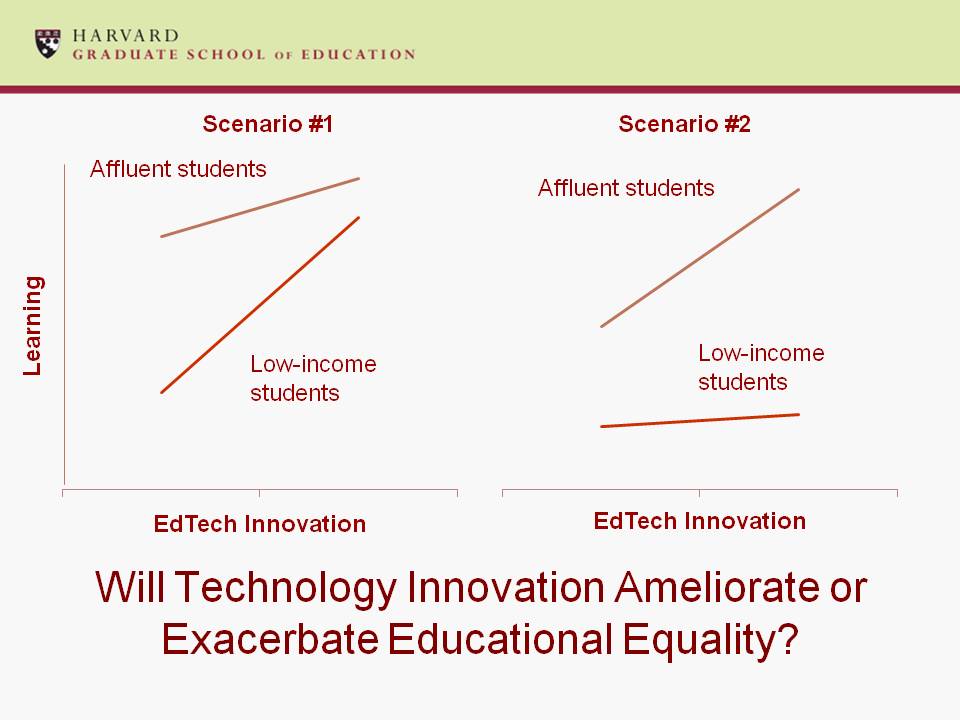
Basically, I think there are two visions for free and Open educational resources and technology, that can be summarized by these two figure:

Two Scenarios of Education Technology and Equity

In the left figure, we have the “closing gaps” vision. In this vision, everyone benefits from new educational technologies, but low-income students disproportionately benefit. The hope here is that as the ecology of education is flooded with new free and nearly free resources, low-income students will have access to resources previously only available to students in schools in affluent places. Take Khan Academy as an example. It’s possible that students in wealthy schools have access to great instructors and plenty of content resources, so Khan Academy is just one more tool in their kit which only offers a minor benefit to these students. But maybe students in schools serving low-income kids have more novice teachers and fewer content and instructional resources, so Khan Academy with it’s free material represents a major boon for these learners. This is a hypothetical scenario of how Khan Academy might disproportionately benefit low-income students.
In the right figure, we have the “rising tide” vision. In this model, everyone still benefits, but now the wealthy disproportionately benefit. From a John Rawls framework, this is still a good thing–everyone is better off than before–but the opportunity gap between wealthy and poor has expanded. Consider Khan Academy again. Maybe teachers in wealthy schools–with fewer students per teacher, more students passing tests, more prep periods, fewer classes to teacher, more curriculum support, more IT support, etc.–are better able to use Khan Academy videos not just to push content to students, but to reimagine pedagogical models. These teachers use the content to flip the classroom, differentiate and personalize instruction, release students from seat time requirements, etc. Any of these new models are possible because teachers can assume that every kid has reliable broadband internet access at home and on their mobile device. By contrast, maybe teachers working in schools serving low income students simply can’t make as much use of the Khan Academy videos because they lack the planning time, broadband access, etc. In this model, schools with greater fiscal and human resources have more capacity to take advantage of even free and open resources.
This second model is actually quite troubling in its implications. If this model is generally true, then virtually every education technology initiative which does not specifically target the needs of particular populations will disproportionately benefit the wealthy, even if the materials are free.
We don’t necessarily have to sit around and guess which model is true, we can use research to answer these questions empirically. This is what I have tried to do with my research with wikis. My assessment of our findings is that in the case of wikis, the second scenario is certainly true. Wikis are more likely to be created in wealthier schools, more likely to persist longer, and more likely to create opportunities for students to develop 21st century skills. Even within schools, wikis are more likely to be used with AP and honors tracked students (who in turn are more likely to be affluent) than with lower tracked students. I don’t think low-income students are harmed by the innovation of wikis, and I think there are plenty of instances where low-income students have had great opportunities with wikis to work collaboratively and create multimedia publications of their understanding. But I am also very confident that wealthy students have benefited much more from these innovations. (This research is forthcoming in Educational Researcher this January, a pre-print paper is in my publications link above.)
Of course, research about wikis doesn’t answer every question about these two models of ed tech and inequality. Are blogs any different than wikis? Possibly, though I can’t imagine why. Are Khan Academy videos different? Possibly, although again, it’s not clear why they would be. But these are empirical questions that we can answer with research.
So if education technology does disproportionately benefit the affluent, what should we do about it? Let me offer three suggestions for teachers, developers and funders.
For teachers, the orientation towards inequality with technology is very important. Educators need to make a commitment to using social technologies with all their students, not just honors and AP students. Many teachers working with at-risk youth are concerned about inequities with technology access within their classrooms, but urban school teachers need to be more concerned with inequities between schools. We need to ensure that urban and rural students have the same opportunities as their suburban peers. We can’t make it so no students in a class have a tech-rich learning experience because some students have difficulty with access. That’s fair within a classroom, but not within a society.
Technologists, designers and researchers need to develop technology initiatives that specifically target the neediest students. TechGoesHome is a fabulous program that provides netbooks and internet connections to students, along with computer training for the entire family. The Glitch Game Testers in Atlanta, have built a program that hires African-American male students as game testers, teaches them the AP Computer Science curriculum, and has an incredible placement rate in not only getting these kids into college, but into engineering and CS majors. Bootstrap is a terrific program that teachers students to program their own video games, developing algebra and computer science skills at the same time. . The Leadership Public Schools use CK-12 Flexbooks to develop content for math and science courses that build literacy skills while teaching domain knowledge. These programs are much more likely to benefit the students who most need our support and investment.
Finally, the big foundations supporting ed tech innovations: NSF, Gates, Hewlett, and MacArthur need to be sure to focus a considerable part of their funding streams on students who most need support. A terrific example of this are the Gates/Hewlett Next Generation Learning grants, which target specific kids in specific high-risk courses. I’m sure down the line that all students will benefit from these kinds of experiments, but if we start by focusing on the kids with the most needs, then we’re more likely to create a scenario where education technology is vehicle for meliorating rather than exacerbating educational opportunity gaps.
So those are some of my thoughts on the topic… obviously there is much more to say.

Facebook flooded with porn spam

 
Facebook is working on its security after a pornographic spam attack that apparently exploited a browser vulnerability.

The attack, which seems to have begun towards the end of last week, saw the timelines of many Facebook users inundated with graphic images of pornography and violence. While this happens from time to time as users fall prey to clickjacking scams, for example, the scale of the recent attack has led Facebook to re-evaluate the safeguards it has in place.
"Recently, we experienced a spam attack that exploited a browser vulnerability," the company said in a statement on Tuesday. "Our team responded quickly and we have eliminated most of the spam caused by this attack. We are now working to improve our systems to better defend against similar attacks in the future. "
The social-networking company added that "protecting the people who use Facebook from spam and malicious content is a top priority for us".
According to Graham Cluley of security firm Sophos, the images shown to unsuspecting Facebook users included "explicit hardcore porn images, photoshopped photos of celebrities such as Justin Bieber in sexual situations, pictures of extreme violence and even a photograph of an abused dog".

Cross-site scripting vulnerability

A statement given by Facebook to ZDNet UK sister site ZDNet.com on Monday suggested the attacks were due to a "self-XSS [cross-site scripting] vulnerability in the browser".
Protecting the people who use Facebook from spam and malicious content is a top priority for us.
– Facebook
Cross-site scripting vulnerabilities are generally found in web applications, and are executed within the browser. These flaws allow criminals to inject malicious code into the actions carried out by the browser. This lets the criminal bypass the browser's security mechanisms and access sensitive data associated with the page.
Self-XSS is a variation on the theme, where spammers trick victims into copying and pasting malicious code into their own browser address bars. Doing so lets the spammer manipulate the browser into posting status updates with malicious links, for example, and generally propagating spam.
According to Sophos, self-XSS attacks often arise from common Facebook spam messages such as "Why are you tagged in this video?".
Facebook said in May it was working hard to improve its systems for detecting and blocking these types of attacks, "as well as to educate people on what is causing their accounts to send spam".
At the time, Facebook said every time its systems noted malicious code had been pasted into the address bar, it would challenge the user to confirm that he or she really meant to do so. It also said it would liaise with browser companies to fix the underlying flaws.

ClearWire may default on debt payment


Clearwire (NASDAQ:CLWR) is weighing whether to skip a $237 million debt payment due Dec. 1 as it tries to conserve its cash, according to Clearwire CEO Erik Prusch.
"It's a very expensive payment that we have," Prusch said in an interview with the Wall Street Journal. "It would be a significant drain of our cash, so we have to evaluate everything in terms of our decision of where we're going."
The mobile WiMAX operator had $698 million in cash and short-term investments on hand Sept. 30 and has enough money to make the debt payment. Skipping the payment could raise concerns about the company's liquidity and whether or not it can stay out of bankruptcy court. Clearwire does have a 30-day grace period after the Dec. 1 deadline to make the payment.
Nevertheless, the news sent Clearwire's shares plunging as much as 31 percent in trading Friday afternoon.
Prusch told the Journal the company is focused on inking more wholesale deals and getting more funding, but declined to comment on whether Clearwire would need to restructure its debts either in or out of bankruptcy court. "We have a number of advisers advising us on all of our strategic options," he said.
Clearwire has said it needs $600 million to deploy a TD-LTE network across its WiMAX footprint. The company's WiMAX netork covers more than 130 million POPs, but has stalled. The company also needs $150 million to $300 million to maintain its legacy WiMAX business. Sprint Nextel (NYSE:S), Clearwire majority owner and largest wholesale customer, raised $4 billion in a debt offering earlier this month and said it may use some of the proceeds to fund Clearwire.
An analyst suggested Prusch may be trying to get leverage over Sprint. "I think they're using the interest payment as a negotiating tactic with Sprint," Mizuho analyst Michael Nelson told Reuters. "Sprint has the most to lose if Clearwire defaults on its debt and files for bankruptcy."

Monday, November 21, 2011

HP's low free cash flow worries analysts

Hewlett-Packard is set to report fourth quarter results after the markets close today, and some company news already has investors jittery.
Specifically, its lack of cash on hand--it spent $11.7 to buy software company Autonomy last month and took a $1 billion charge when it dumped its tablet-computer business--has popped up as the worry du jour for the company, which in September named Meg Whitman CEO, making Leo Apotheker its seventh ex-CEO since 1999.
HP had only $13 billion on hand at t he end of the third quarter, reports The Wall Street Journal, and the concern isn't that HP will go broke, but that it will be unable to make further acquisitions or buy back stock. In addition to Autonomy, HP has recently acquired ArcSight Inc., 3PAR Inc., Palm Inc. and 3Com Corp., all in deals valued at over $1 billion.
"We are also focused on rebuilding our balance sheet, improving our financial flexibility and taking a balanced and disciplined approach to capital allocation," Whitman said when she took the job.
Still, said analysts, the company's balance sheet is relatively strong, despite the $25 billion it had at the end of July.
Today, HP is expected to announce it has continued its trend of the past few years, generating less free cash flow.
The company in August said it expects $8 billion for the year, a steady decline from  $8.4 billion in 2010, $10.2 billion in 2009 and $12 billion in 2008.


Registrars drive 1900% increase in IPv6 adoption

The adoption of IPv6 addresses is on a surprising upswing, according to a new study released by InfoBlox, which found that the number of DNS zones in the .com, .net, and .org subdomains that support IPv6 increased this year by 1,900 percent, from 1.27 percent in 2010 to 25.4 percent in 2011.
The primary driver of this increase? Internet registrars, particularly U.S.-based registrar and hosting provider GoDaddy.
Cricket Liu, InfoBlox
Liu
"There were also a few other registrars internationally that picked up IPv6 support that helped to move the needle," said Cricket Liu, general manager of InfoBlox's IPv6 Center for Excellence, in an interview with FierceTelecom. "But I did not realize that before these results came out that there was that much concentration in that market for hosting zones for other people and that the adoption by a single registrar could move the needle so dramatically."
The IPv6 census has been conducted every year for the past six years for InfoBlox by The Measurement Factory.
GoDaddy's influence is significant-factoring the registrar out of the results shows that the number of zones supporting IPv6 increased organically to 3 percent-but it wasn't necessarily a move GoDaddy wanted to make.
"Clearly there's some pent-up demand on the part of customers of the registrars," said Tom Coffeen of InfoBlox. "GoDaddy did not choose to enable IPv6 support for its DNS services out of the kindness of their heart. Basically, they're feeling the pressure from their customers to enable that support, as other registrars are as well, so that bodes well for continuing adoption of IPv6 in the registrars so the trend should reflect that next year."
Liu optimistically estimated that if other major registrars like Dotster and Network Solutions see a large pickup in IPv6 adoption next year, that the number of DNS zones supporting the addressing protocol could increase to as much as 50 percent.
However, the increase in IPv6 DNS addresses is not the only factor necessary to ensure adoption of IPv6. Many U.S. Internet service providers (ISPs) do not offer IPv6 connectivity to subscribers, meaning companies will still need to run dual-stack nameservers to be accessible to the majority of Internet users.


Top 3 tips for video personalization

US consumers are spending, on average, 19 hours each month watching clips, trailers and full episodes of their favorite programming, and yet video ads account for less than 15% of the total time spend within the video space. That is an indicator that there is still room for video advertising to grow.

by Kristina Knight
I recently chatted with Jim Dicso, President of Sunday Sky, about the possibilities for personalized video advertising. Today, Jim offers his top three tips for personalizing video and three ways video can be used to engage consumers.
First, engagement. Consumers want to be entertained, but with personalized video, brands can do more than entertain - they can convert potential customers. For example, product showcase videos.
"A product showcase video, or a video that shares all-around product information, enhances search engine optimization (SEO) efforts and can increase traffic to product pages by as much as 10%," said Dicso. "When a brand presents a customer with a product he or she wants and then quickly shows the product's features, conversion rates go up."
Jim also suggests creating Personalized video pre-roll ads to present qualified prospects and abandoners with video pre-roll ads that are personalized and generated in real time. Finally, he suggests using personalized video for billing and customer service.
"For example, video bill solutions provide an end-to-end automated video billing presentment. The personalized video clip is designed to address subscribers' needs for clear, friendly and personal explanations of their bills," said Dicso.
As for Jim's top three video personalization tips, he believes Scale, Creative and Measurement are key.
"Video personalization technology should be able to handle thousands of videos and support real-time generation without compromising the user experience," said Dicso. "[Don't] compromise creative quality to achieve personalization...[it] is most powerfull when it comes with a high end, creative treatment. [And] in order to achieve video execution excellence you should always track your results, measure the business value and then work on continuous optimization to achieve the effectiveness of your video communication.

I recently chatted with SundaySky President Jim Dicso about the benefits of video personalization.
Kristina: What are the possibilities for video personalization?
Jim: Personalized videos can be used anywhere within customer lifecycle stages and standard marketing efforts.
Kristina: How does personalization impact online commerce?
Jim: When videos are properly produced, they captivate users. Instead of requiring the user to navigate, scroll and click to access information, online video is a one-stop shop for information. It takes less time to engage the user than reading and that engagement lasts until the user is ready to follow an embedded call-to-action. With today's smart video solutions - generating compelling, personalized, real-time video experiences - companies can easily provide customers with what they need to know in the most engaging, entertaining and informative way possible. This is lucrative, as campaigns with targeted messaging based on users' interactions typically generate 30% higher conversion rates, raise customer value and increase overall profitability.
Kristina: Can there be 'too much' personalization - to the point that it turns the consumer off?
Jim: It depends on the context. If personalization takes place within the customer portal or e-mail where users know what information they have provided to the retailer, we find that customers appreciate the personalization, as it's highly relevant to their shopping experiences. However, when retailers use personalization for targeting or retargeting video ads, they should use personal information sparingly to avoid the impression they have overstepped consumer privacy. There is a fine line between being relevant and being creepy. Brands should be attentive to their user to make sure they haven't crossed the line.

Vodafone plans sweeping cost cuts amid European debt crisis

The ongoing European debt crisis is forcing Vodafone to open a rigorous review of its cost structure for 2012. Vodafone CEO,Vittorio Colao confirmed that he will ask for an in-depth look into company-wide costs in an effort to lessen the impact of Europe's economic slowdown triggered by mounting debt in Greece and Italy.
Colao admitted at the Morgan Stanley Technology, Media and Telecoms conference in Barcelona last week that this action was needed, adding, according to Bloomberg, "because I don't know what the economy will be."
Commenting on the monetary problems and sovereign debt crisis in Europe, Colao said Italy was at a crucial moment in terms of consumer confidence as a new government there decides how to impose austerity measures. He also highlighted the fact that the company had taken a recent write-down in Greece, while Spain is weighed down by a poor market structure and weak consumer spending. However, the UK, Germany and the Netherlands had held up well.
Despite this somewhat gloomy outlook, Colao told Reuters that the group could increase its capital expenditures, such as in the UK, but said it would not be significantly higher. "Can I see a little bit more capex?" he said. "Maybe, but a huge amount? No."
Separately, Colao revealed that tension between Vodafone and Verizon Communications over their U.S. joint venture Verizon Wireless has eased, and the success of new partnerships could determine if that relationship goes any further. "Personally I'm excited that we are doing the right thing," said Colao. "How deep this becomes will determine what eventually will be the final state (between us)."
"We may decide that this is the perfect state...if we don't see anything further we'll say fine, we'll stay here and be good partners, we help them in allowing them [Verizon Wireless] make investments, they give us dividends, we cooperate together," he told Reuters.

Drawing all the wrong lessons from the Euro crisis


Josh Bivens
Josh Bivens


Plenty has been written on this by smarter people than me – but since the troubles of Greece (and now increasingly Italy) are routinely invoked by those arguing that the U.S. needs to move to rapid deficit-reduction, it can’t hurt to emphasize the salient points again.
The cautionary tale one should take from the Eurozone crisis is not the dangers of large deficits. Yes, Greece and Italy do have large public debts – but nowhere near as large as Japan. Yet nobody is talking about a yen crisis. And Spain – often fingered as a likely candidate for a run by the bond-market vigilantes – has a public debt about half as large as that of the UK. And nobody is talking about a pound crisis.
Instead, the cautionary tale one should take from the Eurozone is that the tools of macroeconomic stabilization – fiscal, monetary, and exchange rate policies – need to be taken much more seriously than they have been for decades. Since 1980 a consensus (obviously wrong in retrospect – and not adhered to in real-time by plenty of admirable skeptics) developed among macroeconomic policymakers that fiscal policy should simply aim for balanced budgets (or even surpluses) and should not be used discretionarily to fight recessions; that monetary policy should simply target very low rates of inflation; and that capital markets (including international capital markets) should be left to govern themselves and capital should flow freely across international borders. The underpinning of this consensus was the belief that capitalist economies could and would generally heal themselves quite quickly following recessions, so macroeconomic stabilization policy (the tools used to fight recessions) were mostly unnecessary and would often just impede, not aid, speedy recoveries.
This flawed consensus informed the adoption of the Euro – countries surrendered independent monetary and exchange rate policies because they were sure they weren’t really all that important.
By adopting the Euro and entering a monetary union, member countries lost the ability to print their own currency and to regulate capital flows. So, when borrowing on international markets, they were now borrowing in a currency that they no longer had the capacity to print themselves. This inability to run the printing presses to pay off debt means that they can be forced into default if financial markets players ever decide to stop lending them money on reasonable terms.
Further, the common currency means that important stabilizing forces that kick in when financial markets stop demanding a country’s assets – increased exports and reduced debt obligations driven by the now-weaker national currency – are not operating for individual members of the Euro zone. This exchange rate channel is hugely important for countries trying to recover from financial crises – as the experience of Argentina and Iceland have shown. Further, this abandonment of monetary and exchange-rate policies was not accompanied by a beefing-up of a continent-wide fiscal policy that could be used to buffer downturns.  Michigan or Nevada, for example, do not have their own monetary or exchange-rate policies, but they do get lots of federal transfers (like unemployment insurance) when their economies do more poorly than the national average.
To put this simply – the Eurozone was essentially a ship constructed for the fairest weather possible – a world without recessions. Now that the weather has turned foul, the consequences of not taking macroeconomics seriously is coming clear.
Worse, the too-limited scope that Eurozone countries have for macroeconomic policy stabilization resides solely in the actions of the European Central Bank (ECB) – which is barely even trying to mute the broader economic crisis. As John Quiggin notes, the ECB has actually raised rates within the past year – raising interest rates in the midst of the worst economic downturn in a generation! Recently, the new ECB head has cut these rates – but they remain a full percentage point higher than those in the United States or Japan.
So, what do we really have to learn from the Euro crisis? That the tools of macroeconomic management matter a lot – and they should not be given up casually. Failing to heed this lesson is already hurting the U.S. economy.

Tech in The Next Five Years

Bolaji Ojo

Copyright isn't working, says European Commission

People have come to see copyright as a tool of punishment, Europe's technology chief has said in her strongest-yet attack on the current copyright system.

Digital agenda commissioner Neelie Kroes said on Saturday that the creative industries had to embrace rather than resist new technological ways of distributing artistic works. She added that the existing copyright system was not rewarding the vast majority of artists.

"Is the current copyright system the right and only tool to achieve our objectives? Not really," Kroes said in a speech to the Forum D'Avignon thinktank. "Citizens increasingly hear the word copyright and hate what is behind it."

"Sadly, many see the current system as a tool to punish and withhold, not a tool to recognise and reward," Kroes added.

The commissioner said online distribution and cloud computing offered a "totally new way of purchasing, delivering and consuming cultural works", and suggested that the existing legal framework around copyright was not flexible enough to take advantage of this evolution.

Rights-holders have long complained about the damage done to their industry by online copyright infringement. Governments and courts in countries including the UK have responded by blocking access to websites that help people unlawfully share music, videos, games and software.

Some countries, such as New Zealand and France, also threaten repeat infringers with suspension or disconnection of their broadband services.

Kroes's speech was not the first time the creative industries have been taken to task for not sufficiently adapting to the digital age. The commissioner herself has said she intends to overcome the content industry's failure to agree pan-EU licensing deals, and the fact that countries such as the UK tax e-books more highly than they do physical books.

According to Kroes, in one large EU country 97.5 percent of artists earn less than €1,000 (£856) a month from the copyright system. "This is a devastatingly hard way to earn a living," she said.

The commissioner did not provide any definitive answers as to what should replace the current copyright system, apart from saying it those advocating new business models should get a fairer hearing than they do at present.

"In times of change, we need creativity, out-of-the-box thinking: creative art to overcome this difficult period and creative business models to monetise the art," Kroes said. "New ideas which could benefit artists are killed before they can show their merit, dead on arrival. This needs to change."

The search for Pafsanias: fifteen years on.


Dear  Friends,


King’s College London Alumni Association of Greece has the pleasure to invite you to the second ‘Koraes’ Lecture, that will be given by Dr. Karim Arafat, Reader Emeritus in Classical Archaeology and former Director of the Centre for Hellenic Studies at King’s College London, entitled The search for Pafsanias: fifteen years on.


Sunday 27 November 2011


18:30:               Welcome Coffee

19:00:               ‘Koraes’ Lecture, by Dr. Karim Arafat

20:30:               Cocktail Reception

Location:           National and Kapodistrian University of Athens, 'Kostis Palamas' Building

Address:           Akadimias Street 48 & Sina Street, Athens

Metro:               Panepistimio

Dress code:       Smart casual

RSVP:              By replying to  edinpress@gmail.com by Wednesday 23 November 2011


Great opportunity to meet old friends, make new friends, all this in a friendly, warm and enticing atmosphere.
P.S.      Please reply as soon as possible for catering purposes.