Friday, February 24, 2012

HP revenue takes a tumble as key units suffer


HP's revenue fell seven percent in the first quarter, as the technology giant failed to hold income in important units steady, putting it behind competitors Dell and IBM.
Meg Whitman
HP boss Meg Whitman has multiple challenges ahead of her after first-quarter revenue fell seven percent and HP took a big hit from hard-drive shortages.Image credit: Jack Clark
On Wednesday, HP reported revenue of $30bn (£19.1bn) for the three months ending 31 January, down from $32.12bn the previous quarter and from $32.30bn in the same period in 2011. Earnings rose 600 percent to $1.5bn from$239m in the fourth quarter, when HP wrote off $788m from winding down its WebOS unit, but dropped 44 percent year-on-year.
"Frankly, it was a tough quarter, and every [HP business unit] had its challenges," chief executive Meg Whitman said on an earnings conference call.
The hard quarter comes after a tough 2011 for HP. Like its rivals, it has been hurt by a dramatic rise in hard-disk prices after flooding hit Thai production facilities. Unlike them, however, it has faced a costly and difficult legal spat with Oracleover support of HP's waning Itanium processor.
It has also worried customers by ditching its WebOS operating system and publicly considering the sale of its lucrative PC unit, and had to adapt to a swift turnover in chief executives. It also made a huge acquisition, spending £7.1bn on UK-based software analytics company Autonomy.

Hard-disk price rises

Whitman blamed hard-disk price rises, which hurt revenue for HP's personal and enterprise business units, as partly responsible for the poor first-quarter results. She also pointed to difficulties breaking into China and a worrying seven percent year-on-year fall in revenue for the "lifeblood of HP", its imaging and printing unit.


That estimate suggests disk-drive problems were responsible for $1bn of the $2bn drop in overall takings at the company. "We were not as effective as we needed to be in matching that [reduced drive] supply with our demand," Whitman said."We estimated that more than half of the revenue decline was due to the hard-disk drive shortage," HP's chief financial officer, Catherine Lesjak, said on the call.
HP rivals Dell and IBM had also been hurt by the price rises, but their earnings suffered to a lesser extent in the last three months. Dell took a hit of $150m on hard drives in the fourth quarter, in which it saw revenue rise two percent year-on-year to $16bn, it reported on Tuesday. For its fourth quarter, IBM reported revenue of $29.5bn, an increase of four percent on the previous quarter.
Overall, HP's top four units by revenue — the Personal Systems Group; Services; Imaging and Printing Group; and Enterprise Servers, Storage and Networking — all saw their takings shrink on a quarter-on-quarter and year-on-year basis. Collectively, these four divisions turned over $28.7bn, representing the lion's share of the company's revenue and a contraction of eight percent on the $31.3bn taken in the previous quarter.
The sole bright spots were in the software division — where revenue fell 7.5 percent on the previous quarter but rose 24 percent on the previous year — and the Financial Services division, which was slightly down on the previous quarter but up 13 percent on the previous year.

Whitman's strategy

"I think the magnitude of the task that Meg Whitman faces is becoming apparent," Simon Robinson, research director at 451 Research, told ZDNet UK. "HP is challenged on a number of fronts — it's too big, it's lost its mojo around innovation, it's grown through acquisitions, and it seems that era is over."
 HP is challenged on a number of fronts — it's too big, it's lost its mojo around innovation, it's grown through acquisitions, and it seems that era is over. 
– Simon Robinson, 451 Research
Whitman's strategy is to translate HP's breadth of hardware and software products into becoming an end-to-end IT company, much like IBM, Robinson said. They want to do everything "from printing your boarding documents to actually managing the airline reservation system", he suggested. HP is not alone in this: Dell plans to make the same transition.
However, the company faces a large number of challenges, not least of all that under former CEO Mark Hurd, it cut back on its research and development efforts. This means there are fewer innovations in the pipeline for Whitman than in previous years.
"IBM wrote the blueprint for how to build a profitable services business," Robinson said. "HP has kind of gone through the motions, but it hasn't invested enough in building a profitable services business."
Whitman said on the call she expects the difficulties will continue for HP a few quarters. She predicted that if things go well and the global economic system does not take another downturn, HP revenue could return to growth by the end of 2013. 
On the call, HP executives did not touch on the Project Moonshot scheme to add low-power ARM processors into its servers and consumer devices. "My impression is that's still at an embryonic stage," Robinson said.

Wednesday, February 22, 2012

Verizon LTE Blackout


Verizon Wireless (NYSE:VZ) appears to be in the midst of yet another LTE service outage, a situation that contrasts sharply with the carrier's relentless "most reliable network" marketing.
"VZW is investigating customer issues in connecting to the 4G LTE data network. 3G data, voice and text services are operating reliably," Verizon said in a Twitter statement.
According to various reports, the outage has affected Verizon LTE customers across the country.
A reader comment on Engadget summed most users' position on the topic: "I've had my Galaxy Nexus since Dec 20th and this is like the 3rd outage I've had to suffer through. However, I think it's like the 5th outage since the beginning of December 2011. Outages will happen...but...get it together Verizon...we pay you a lot of money each month so we expect our service!"
Verizon experienced three brief LTE outages in December and four overall in 2011 (it also had an outage in April).  In December, Verizon explained that the 2011 outages were due to technical problems with Verizon's IP Multimedia Subsystem architecture. Alcatel-Lucent (NYSE:ALU) and Nokia Siemens Networks are the key suppliers for Verizon's IMS network. (Alcatel-Lucent and Ericsson (NASDAQ:ERIC) are Verizon's main radio access network vendors for its LTE network.) Verizon said customers lost service because the carrier's IMS core could not recognize them.
Verizon's LTE network now covers 196 markets and more than 200 million POPs.

Monday, February 20, 2012

Rumour mill: Telefónica Spain to select Alca-Lu for LTE network


www.lteworld.gr


Telefónica Spain is expected to announce that Alcatel-Lucent is to provide the company with a nationwide LTE network, according to a Bloomberg report.
Sources close to the negotiations say that Alca-Lu is ahead of rival LTE infrastructure suppliers, with a formal decision anticipated when Telefónica unveils details of its future network strategy at the Mobile World Congress trade show in Barcelona, Spain. The companies didn't comment to Bloomberg.
Rumours of the deal, speculated to be worth around €300 million to provide LTE coverage to 65 per cent of the Spanish population, boosted Alca-Lu's share price €0.085 to €1.85 in Paris, valuing the company at €4.3 billion.


Commenting on the suggested contract award, Robin Bienenstock, an analyst at Sanford C Bernstein in London, noted that Telefónica needs to deploy LTE in an effort to regain subscribers that have been lost to fixed and mobile operators providing faster broadband services.
"LTE will be important, especially in rural areas" where download speeds may be limited to about 2 Mbps, Bienenstock said. "In the absence of significant cable coverage, Telefónica's wireline customers are threatened by faster speeds available through LTE, hence the company has to build LTE to prevent further revenue declines in these areas."
Last September, Telefónica announced that Alca-Lu had been selected to help the telco test LTE services for business users in Madrid and Barcelona. Huawei has been providing LTE dongle modems for use in the trial.
Data compiled by the market research firm Dell'Oro Group has Alca-Lu holding 30 per cent of the LTE market as of September 2011, trailing Ericsson's estimated 44 per cent market share.


www.lteworld.gr

Friday, February 17, 2012

Sprint announces job cuts as part of reorg


Sprint Nextel (NYSE:S) confirmed it will cut an unspecified number of jobs as part of the senior level reorganization it announced in January.
"In early January, we announced changes at the senior officer level to consolidate business and consumer sales, business and consumer marketing and wholesale and M2M," Sprint's Scott Sloat, confirmed in an email to FierceWireless. "The latest job reductions are a further extension of this consolidation. Sprint's workforce is approximately 40,000 employees, and we do not expect this to change significantly with this reorganization. Sprint continues to hire new employees into positions that support our corporate strategy."
The number of positions affected likely isn't more than 100, and the cuts will go into effect in March, according to people familiar with the company's plans who asked to remain anonymous.
Sprint in January said it will merge its consumer and enterprise sales and marketing divisions and will lose four executives as part of a corporate reshuffling aimed at streamlining the carrier's operations as it works to finance its network upgrade and iPhone launch.
As part of the overhaul, Paget Alves, currently Sprint's president of business markets, will head Sprint's consumer sales as its chief sales officer. Bill Malloy will lead Sprint's marketing for both consumer and enterprise markets. Further, Danny Bowman, the president of Sprint's machine-to-machine business unit, will leave the company, and Matt Carter, currently head of Sprint's wholesale business, will take over the carrier's M2M portfolio. Robert H. Johnson, head of Sprint's consumer business, John Carney, head of consumer marketing, and Chris Rogers, a Sprint executive who worked on corporate development and spectrum, will all leave Sprint.
"Because of the enormous investments we're making this year in Network Vision and in the iPhone, we need to consistently be looking for ways to be more efficient," Sprint CEO Dan Hesse wrote in announcing the changes in January.

Report: Google bypassed iPhone privacy settings to track web users


Google (NASDAQ:GOOG) and other digital advertisers employed special code to bypass user privacy settings across millions of Apple (NASDAQ:AAPL) iPhones and desktop computers running the Safari web browser, The Wall Street Journal reports.
According to the Journal, Google and ad firms Vibrant Media, PointRoll and WPP's Media Innovation Group leveraged code that essentially tricks Safari (the most widely used mobile browser) into letting them monitor user behaviors despite Safari default settings designed to block such tracking. Stanford University researcher Jonathan Mayer first identified the code, which was subsequently confirmed by technical advisor Ashkan Soltani--in tests, Soltani determined that ads on 22 of the top 100 websites installed the Google tracking code on the desktop, and ads on 23 sites installed it on the iPhone.
Google has since disabled the code. "The Journal mischaracterizes what happened and why," Google said in a statement. "We used known Safari functionality to provide features that signed-in Google users had enabled. It's important to stress that these advertising cookies do not collect personal information." Google adds that all cookies were built to expire within 12 to 24 hours.
Apple told the Journal it is "working to put a stop" to code that circumvents Safari privacy settings.
Google is no stranger to controversy over user privacy. Last month, the digital services giant announced plans to connect user data across desktop and mobile services including Google+, Gmail and YouTube. Google presently maintains more than 70 privacy documents covering its different products--on March 1, it plans to consolidate more than 60 documents into its main Privacy Policy. Separate policies will continue to govern products including the Chrome web browser and the Google Wallet m-commerce platform.
The new policy follows Google's recent settlement with the U.S. Federal Trade Commission that subjects the company to 20 years of privacy audits. Google also has come under heavy regulatory scrutiny in Europe. Google hopes "that by creating a one-stop shop for privacy policy it will deflect regulatory action," Center for Digital Democracy executive director Jeff Chester told the Associated Press.
But consumers who log into Google services won't be able to opt out of the revamped guidelines, which has critics crying foul. "Google's new privacy announcement is frustrating and a little frightening," Common Sense Media chief executive James Steyer told The Washington Post. "Even if the company believes that tracking users across all platforms improves their services, consumers should still have the option to opt out--especially the kids and teens who are avid users of YouTube, Gmail and Google Search."
Google later sent a letter to Congress to assuage lawmaker concerns, maintaining that it is revamping its privacy policies but not changing corresponding controls. "We'll continue to focus on providing transparency, control and security to our users," writes Google director of public policy Pablo Chavez in a Jan. 30 letter addressed to eight members of the U.S. House of Representatives. "In fact, the announcement of changes to our privacy policy is a great example of our effort to lead the industry in transparency. It's been the most extensive user notification effort in Google's history--including promotions on our homepage, email to our users, just-in-time notifications and more--to ensure that our users have more opportunities to learn about these changes."
Chavez explains that Google is striving to make its privacy policies simpler and more accessible to users, changes lawmakers and regulators have requested. "We're still keeping your private information private--we're not changing the visibility of any information you have stored with Google," Chavez writes on the Google Public Policy Blog. "We're still allowing you to do searches, watch videos on YouTube, get driving directions on Google Maps and perform other tasks without signing into a Google Account. We're still offering you choice and control through privacy tools like Google Dashboard and Ads Preferences Manager that help you understand and manage your data. We still won't sell your personal information to advertisers. We're still offering data liberation if you'd prefer to close your Google Account and take your data elsewhere."
Chavez also responded to the opt-out controversy. "We understand the question at the heart of this concern. We believe that the relevant issue is whether users have choices about how their data is collected and used. Google's privacy policy--like that of other companies--is a document that applies to all consumers using our products and services. However, we have built meaningful privacy controls into our products, and we are committed to continue offering those choices in the future."

Clearwire to give first TD-LTE Services in June 2013


http://www.lteworld.gr


Clearwire (NASDAQ:CLWR) intends to have its first wave of TD-LTE 5,000 cell sites up and running by June 2013, the company said. Clearwire CEO Erik Prusch made the comments during the company's fourth-quarter earnings conference call.
Prusch said Clearwire has been working with Sprint Nextel (NYSE:S), its majority owner and largest wholesale customer, to identify sites for Clearwire's planned TD-LTE network, which will overlay the company's existing WiMAX network. He said Clearwire expects to begin the buildout near the end of the first quarter. Clearwire is looking to deploy its LTE Advanced-ready TD-LTE network mainly in urban areas, where traffic is heaviest.
The Clearwire chief said that "not too terribly long" after the first 5,000 sites are online, Clearwire will expand that coverage to 8,000 sites. Interestingly, he added that with the TD-LTE network Clearwire will not be as focused on POPs covered as it as with its WiMAX network, and will instead focus on how much data traffic it can transmit across its network--presumably to get as much as wholesale revenue as possible.
Under the terms of financial and network agreements Sprint and Clearwire reached in December, Sprint will pay Clearwire up to $350 million in a series of prepayments over a period of up to two years for LTE capacity if Clearwire achieves certain buildout targets and network specifications by June 2013. Sprint and Clearwire said the agreements also establish long-term, usage-based pricing for LTE services.
During the call, Clearwire CFO Hope Cochran said that of the total $900 million Clearwire will receive for Sprint's unlimited retail WiMAX usage in 2012 and 2013, $600 million will be paid in 2012 with the remainder in 2013. Additionally, Clearwire will get $87 million this year under the terms of its previous Sprint agreement, bringing total 2012 cash payments to $687 million, well above the the $434 million cash payments the company received from Sprint in 2011. She said the funds "will support our liquidity position until 2013, when we will be in a position to benefit from the additional LTE revenue stream as our LTE sites go live and devices become available."
Prusch also said that as the company works on its LTE buildout it will continue to work with China Mobile and other TD-LTE carriers to accelerate the development of TD-LTE devices. Prusch noted that "Sprint has stated that they expect to have 2.5 GHz-compatible multiband, multimode LTE devices in market in 2013, ready to take advantage of our network as it goes live throughout the year."
Additionally, Prusch touched obliquely on the FCC's recent decision to not allow wholesale LTE provider LightSquared to launch commercial service--a move that removes a competitor to Clearwire and could funnel additional business toward Clearwire. He said Clearwire is actively looking for new wholesale customers and that adding more is a key priority for 2012. "We continue to field a lot of inbound inquiries in terms of wholesale deals," he said, according to a Seeking Alpha transcript. "But we're pleased with the pipeline of opportunities that we've got in front of us and that's about as far that I'd like to go with that."
He noted that Clearwire recently added MVNE Simplexity and "freemium" mobile broadband provider FreedomPop, which had been a LightSquared customer, as wholesale customers. Prusch said Clearwire will continue to adopt usage-based pricing agreements for its wholesale customers.
Subscribers: During the quarter Clearwire added 873,000 total net new subscribers, reflecting 904,000 net new wholesale subscribers and a net loss of 31,000 retail subscribers. (Clearwire's wholesale subscribers consist primarily of Sprint 3G/4G smartphone customers). The company ended the fourth quarter with around 10.4 million total subscribers, up 140 percent from 4.3 million subscribers at the end of 2010. The carrier's subscriber base consists of 1.3 million retail subscribers and 9.1 million wholesale subscribers.
ARPU: Clearwire's retail average revenue per user was $46.69, up from $45.52 in fourth quarter of 2010. The company's wholesale ARPU was $6.34 in fourth quarter 2011, up from $3.52 in the fourth quarter of 2010.
Churn: Clearwire's retail churn was up slightly to 3.9 percent, up from 3.8 percent in the year-ago quarter. The company's wholesale churn was 2.9 percent in the quarter, higher than 1.4 percent in the year-ago period. During the company's conference call, Cochran said that the increase in wholesale churn was primarily associated with Sprint's introduction of Apple's (NASDAQ:AAPL) iPhone in the quarter. However, Cochran said that because of Sprint's long-term commitment through 2015 to Clearwire's WiMAX network, Clearwire doesn't expect wholesale revenue from Sprint to be impacted substantially.
Financials: Clearwire's total fourth-quarter revenue clocked in at $361.9 million, up from $175.2 million in the year-ago period. Wholesale revenue in fourth quarter was a record $164.1 million, while retail revenue and other revenue was $197.8 million. Clearwire's net loss for the fourth quarter was $236.8 million, wider than the net loss of $128 million in the year-ago period. Clearwire reported adjusted EBITDA of $22.5 million, compared with an adjusted EBITDA loss of $46.4 million in the third quarter. It was the company's first positive adjusted EBITDA result and Clearwire achieved it a quarter earlier than expected.
Capital expenditures: Cochran affirmed that the cost of the LTE overlay will be $600 million. She said that Clearwire's capital expenditures in 2012 are expected to total around $450 million to $550 million, with most of the spend occurring in the second half of the year. She also said Clearwire is close to securing $200 million worth of vendor financing and may receive more in 2012.


http://www.lteworld.gr

Wednesday, February 15, 2012

How to Create your own PodCast


Many marketers resist using podcasts as a marketing tool, even though they can be an effective way to engage an audience. That's likely because creating a podcast seems much too complicated and difficult. But it needn't be, says Mack Collier in his MarketingProfs article "Ten Steps to Creating Your Own Podcast." You just need to know which bases to cover and then plan, research, test, and practice... till you get it right. The following are among the bits of useful advice he offers.
Understand what podcast listeners want. "Read what podcasting message boards, forums, and blogs have to say about the content and format of their favorite shows," says Collier. Then listen to highly rated podcasts and see whether you can add similar elements to your podcast. But Collier also suggests you also ask yourself, "What will your podcast give them that they can't find elsewhere?"
Determine your show format. Keeping your schedule predictable makes increasing your show's audience easier. So decide the length of your show and how often and when to publish episodes, Collier says. He also suggests you prepare a list of topics and a schedule of guests well ahead of time.

Figure out what equipment to use. "Consider how often you will be using your equipment and what your budget will be," Collier says. You should focus first on the microphone, which is the most important piece of equipment, he points out. The most expensive equipment isn't necessarily the best; and even if it is, it might be more than you need.
Select your recording software. Free recording software, such as Audacity and Garage Band, make recording, editing, and publishing your podcast relatively easy.
Start practicing. Write the layout of your show and begin rehearsing. Jot down points you want to make and when to make them. Then practice. "You want to rehearse, but you don't want to script the entire show's content, because [then] it comes across as forced," says Collier.
Record the main body of the show. Record it in sections so it's easier to edit them. Consider recording it in this order: intro, topic 1, topic, 2, then recap, and close. Remember to record in a quiet environment to avoid background noise that can be picked up by your microphone.
Select and edit music. If you wish to use music, use your recording software to add music at the beginning and end of your podcast. Music should fade out and in for each segment. Unless you want to shell out cash, use royalty-free music that owners have given the public permission to use.
Select a hosting service. "After you have your show recorded, and it's ready to be published, you'll need to select a hosting service," Collier explains. Consider the file size of your podcast episodes and how many you will produce each month.
Promote the podcast. Share the news of your podcast on social networks and your blog. If you don' have a blog, promote it on your site "or, better yet, create a separate blog for your podcast," Collier suggests.
The Po!nt: Creating a podcast is not as hard as you probably think it—but you do need to do your homework first.


The Number Of Mobile Devices Will Exceed World’s Population By 2012

www.lteworld.gr


multiple-devices-2016
Despite its long and boring name, Cisco’s “Visual Networking Index (VNI) Global Mobile Data Traffic Forecast Update” is one of the more fascinating data-filled reports you’ll read this year. The report examines the dramatic growth we’re seeing in the mobile Internet space, including the massive demands for mobile data, the growth of mobile video, and the rise of the smartphone as new gateway to the web itself.
Globally, mobile data traffic grew 2.3-fold over 2011, more than doubling for the fourth year in a row. The traffic even grew faster than Cisco had earlier predicted: they had pegged growth at 131% year-over-year. In actuality, traffic grew by 133%.
In 2011, mobile data traffic was 8 times the size of the entire global Internet in 2000 (597 petabytes vs. 75 petabytes). That was only a dozen years ago, but it may as well have been eons.
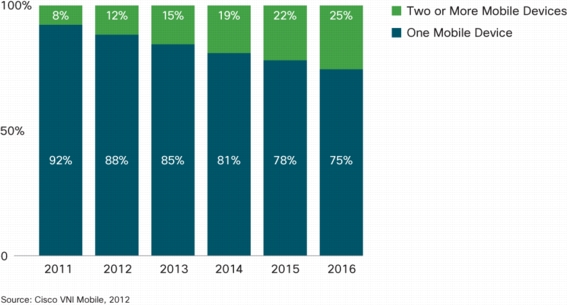
And, in one of the report’s more telling figures, the number of mobile-connected devices will exceed the number of people on earth by the end of 2012. By 2016, there will be 1.4 mobile devices per capita. That year, there will be over 10 billion mobile-connected devices, including machine-to-machine (M2M) modules. Again, the number will exceed the world’s population at that time (7.3 billion).
VIDEO
The mobile web’s growth, and its unending need for more data, more connectivity and more bandwidth, shows no signs of slowing. One of the top activities for mobile users in particular, is mobile video. For the first time, video accounted for over half of all traffic (52%). This is, in part, due to the increases in connectivity and phones capable of video viewing. By 2016, video will be over 70% of traffic.
Video’s growth can also be attributed to the increases in devices that can do more, faster at greater speeds, which help to impact the global bottom line in terms of data usage. Case in point: 4G phones, only 0.2% of mobile connections, are already accounting for 6% of mobile data traffic. By 2016, 4G will reach 6% of all connections, but 36% of total traffic, or 9 times that of non-4G phones.
The top 1% of mobile data subscribers, meanwhile, account for 24% of data traffic. And smartphones as a group, still a minority representing only 12% of the total handsets in use today, now account for over 82% of global handset traffic.
MOBILE CLOUD
In some cases, mobile cloud apps are video apps (think YouTube and Netflix), but other times they’re music (Pandora, Spotify), gaming, or social networking apps. But the increases in mobile connectivity have allowed what would otherwise be limited hardware devices to function as tools for media consumption.
A user with an 8 GB smartphone who streams music and video will consume more content over 2 years that can be stored on the device itself. And a smartphone owner who uses Netflix, Pandora and Facebook will generate more than twice the volume of traffic as generated by a smartphone owner only using email and web apps.
SMARTPHONES
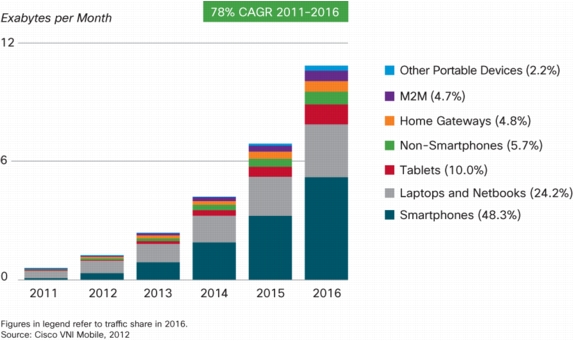
Smartphones are growing in popularity and usage, too, as indicated by the increases in the group’s data traffic demands. In 2011, the average smartphone usage nearly tripled, up from 55 MB/month last year to 150 MB/month today. By 2012, over 100 million smartphone users will be using over 1 GB/month of data. And by 2016, the monthly global smartphone data traffic will pass 10 exabytes per month, with the average smartphone generating 2.6 GB/month, a 17-fold increase from 2011′s average.
FEATURE PHONES
Even though the perception in developed markets like ours is that smartphones are everywhere, the majority of the mobile market is still using basic handsets. In 2011, these devices accounted for 88% of the mobile landscape, and their mobile data usage increased 2.3-fold to 4.3 MB from 1.9 MB last year. In other words, even “dumb phones” are getting smarter, and capable of consuming more mobile data.
TABLETS
But the mobile web is no longer accessed by handsets alone. Tablets are a growing group, too, with their own data demands. The number of mobile-connected tablets tripled last year to 34 million, each generating 3.4 times more traffic than the average smartphone (517 MB/month vs. 150 MB/month for smartphones). By 2016, tablets will be 10% of global mobile data traffic.
Or, in what may be my favorite number from the report: by 2016, mobile-connected tablets will generate almost as much traffic as the entire global mobile network does in 2012, 1.1 exabytes per month. (The global network will reach 1.3 exabytes/month next year). Think about that: the tablet Internet will grow that quickly to become the size of this year’s mobile Internet. If you’re working on anything in the mobile space and have put off addressing how you’ll meet the needs of the tablet user, you’re already behind. And it goes without saying that if you’re building for the web and haven’t addressed mobile, you’re basically just lost.
ANDROID VS IPHONE
Finally, what good mobile data could refrain from weighing in on the Android vs. iPhone battle? In terms of data consumption, it appears Android is winning (well, using more data – I’m not sure if that’s “winning.”) As Android apps are freer to run in the background, the figure is not so surprising. But this is also a function of Android’s increased global market share. Today, Android devices’ data consumption is 29% higher than Apple devices in terms of megabytes used per month per connection.

Security Concerns Hampering Social Commerce


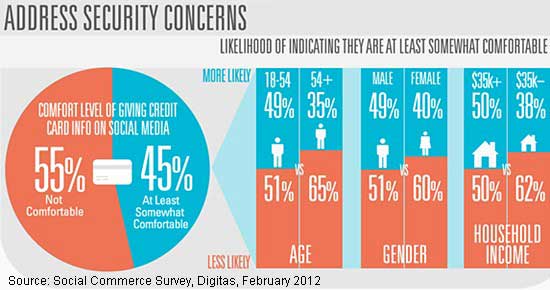
More than one-half (55%) of social media users in the US say they are uncomfortable sharing credit card information with a known brand via secure payment on a social networking site such as Twitter or Facebook, according to a new survey from Digitas.
Moreover, women, who tend to outnumber men on most social networks, are more likely than men to say they are uncomfortable handing over credit card information (60% vs. 51%) in order to complete transactions on social sites.
However, 45% of all surveyed social media users say they would be at least somewhat comfortable sharing their credit card information. Among those 45% of users: 
  • Those age 18-54 are more likely than their older counterparts (age 54+) to say they are at least somewhat comfortable sharing their credit card information, 49% vs. 35%.
  • Men are more likely than women to say so, 49% vs. 40%.
  • Those with an annual household income of $35,000+ are more likely than those earning less than $35K to say so, 50% vs. 38%. 
Below, additional findings from the Digitas survey of US social media users, conducted by Harris Interactive.

Accessing Social Sites via Mobile
The survey also revealed insights into the amounts of time spent people spend on social networks via mobile devices, as well as spikes in mobile usage patterns across age and gender.
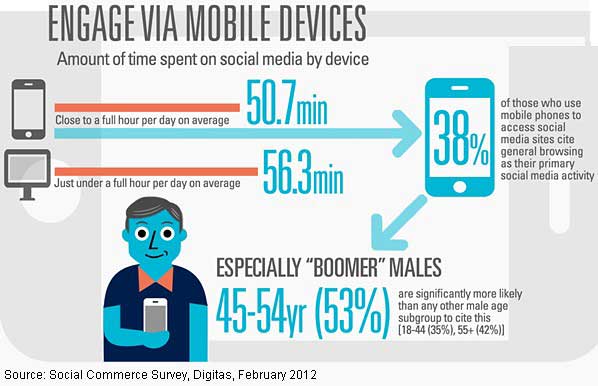
Social media users who use their mobile phones to access social media sites spend nearly one hour per day on average (50.7 minutes) on social sites via a mobile device. By contrast, social media users who access social sites via laptop or desktop computer spend 56.3 minutes per day on average.
Moreover, 38% of social media users who use their mobile phones to access social media sites cite general browsing (e.g., scrolling through updates, visiting brand pages, "liking," or "following" posts) as their primary social media activity. Men age 45-54 (53%) are more likely than younger men (age 18-44) (35%) or those age 55+ (42%) to cite the same.
Friend Recommendations Beat Likes
Fully three in four social media users (75%) say they would be more likely to purchase a product or service endorsed by a friend (writing about it or recommending it) on a social media site than by a brand they "like" or "follow."
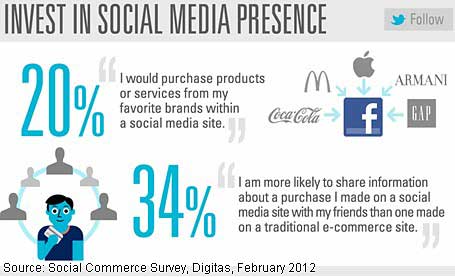
Meanwhile, more than one-third (34%) of social media users say they would be more likely to share information about a purchase they made via a social media site with friends than one made via a traditional e-commerce site:
Some 20% of social media users say, if able to, they would likely make group purchases from a brand on a social media site with friends.
Virtual currencies have little influence: 74% of social media users say, if given the option, they wouldn't use virtual currency, such as Bitcoin or Facebook Credits to pay for a purchase made via a social media site.
Other findings among surveyed social media users: 
  • 20% say, where possible, they would purchase products or services from their favorite brands on a social media site.
  • 18% say they are more likely to make a group purchase (i.e., planning and paying for a trip with friends or purchasing a joint gift) via social media vs. a traditional e-commerce site.
About the data: The Digitas survey was conducted online among 2,630 US adults age 18+, of which some 2,247 were identified as social media users, Jan 12-16, 2012.


Turning Transactions into Social Experiences


In this article, you'll learn...
  • How one company used Twitter and landing pages to boost sales and deepen engagement
  • Why creating personalized social experiences around purchases can be a powerful approach

Company: Rickshaw Bagworks
Contact: Chris Schroeder, marketing communications manager
Location: San Francisco, Calif.
Industry: Accessories
B2B/B2C: B2C
Annual revenue: Confidential
Number of employees: 25
Quick Read
One can hardly deny that online testimonials are valuable, but those generally come after the sale. What if you could start that engine earlier by introducing a social component while customers are still excitedly anticipating the arrival of their new purchases?
Custom bag manufacturer Rickshaw Bagworks found a way—using a potent blend of Twitter and personalized landing pages—to notify customers, applaud them on their selections, introduce their friends to the brand, and encourage additional sales.
That approach may require an extra boost of creativity to work for some products and services, but it could be well worth the effort. Just wait until you get a load of the results from this campaign.


Challenge
Rickshaw Bagworks is a San Francisco-based company that designs and manufactures made-to-order messenger bags with a focus on sustainable design, minimal-waste manufacturing, and eco-friendly materials.
Like the personalized nature of its products, the company strives to deliver unique buying experiences that help customers forge more intimate connections with its brand. Local customers, for example, can visit the company's facilities, meet the team, and select the fabrics that will be used to make their bags. Building these types of connections also supports word-of-mouth, so it made sense for the company to try to emulate that experience online.
"We were looking for some way to personalize the online transaction and bring the same excitement as when someone comes to the factory," says Chris Schroeder, marketing communications manager at Rickshaw Bagworks. "We also wanted to socialize our e-commerce transactions and give them a more emotional component so that we could share beyond our own network by creating something people want to share with their networks, as well."
Campaign
Via research, Rickshaw Bagworks singled out Twitter as the social network most widely used by its target audience, best for customer service-focused initiatives, and easiest for quickly disseminating information and timely updates.
Accordingly, the company began asking customers to provide their Twitter handles during the checkout process. Company staff then started snapping pictures of each new bag before it was shipped, uploading those images to Twitpic, and tweeting those images out to followers. Each post included the customer's Twitter handle and the hashtag #FreshBagFeed for tracking (e.g., "Tweed meets camouflage. We're in LOVE. Great choice @floflidesign #FreshBagFeed").
"This is different than the average social media post," Schroeder explains. "We're giving them a personal stake in it, and it's a way to get them excited about what's coming."
The idea was a good one, except that the Twitpic landing pages that displayed each photo didn't effectively support the Rickshaw Bagworks brand experience. The pages displayed third-party ads, including some from a major competitor. So the company turned to fellow-San Francisco firm BO.LT for assistance in developing a better, branded landing-page program for this effort.
BO.LT developed a page template that matches the Rickshaw website aesthetic. The template can be personalized for each order by simply including the two star elements—a photo of the customer's made-to-order bag and the tweeted message that led the customer to the page.
"Tweet" (Twitter) and "Like" (Facebook) buttons are clearly displayed below each personalized message to encourage sharing. In addition, the page includes a "Design your own!" call-to-action button for referred visitors, and displays links to follow the company on Facebook, Flickr, Twitter, and Vimeo.
The page also features a behind-the-scenes video of how the bags are made and who makes them. That works to both forge a more personal connection with customers and increase confidence among prospective buyers.
"We want to make sure that if the link gets shared and the people who land there have never heard of us, they can get introduced to our brand and click through to our actual site," says Schroeder.
He adds that this approach provides advantages in search engine optimization (SEO), as well, particularly because each call-to-action button serves as an inbound link for the company website.
Bottom-Line Results
Schroeder says 60% of online customers respond to those messages in some fashion, either by retweeting or replying.
"They're like online reviews. People are excited about their purchases, and other people are hearing a lot of goodwill [toward our brand]," he says.
Most of the landing pages are receiving a minimum of 10-15 views. One received more than 1,500 views, though that's unusual; highs typically range between 300 and 500 views.
More important, the click-through rate from those pages to the Rickshaw website averages between 15% and 24%, and an estimated one out of every hundred views results in a new sale.
Lessons Learned
The following are key to successfully running this type of campaign:
  • Producing something share-worthy. Because its product is the customer's own creation, Rickshaw Bagworks didn't have to do much persuading to motivate customers to share and show off their good work. But you can achieve the same effect, even if your product or service isn't the most engaging, by making the campaign personal and prompting your customers to create or contribute something that truly matters to them or makes them proud.
  • Making it easy to share. Integrate recognizable share buttons for the major social networks into your page design so that your audience can spread the word about you with a click. AddThisShareThis, and GetSocial Live are popular plug-ins you can use. 
  • Closing the loop. Every landing page should include a call to action for its intended audience. In this case, Rickshaw Bagworks includes multiple calls to action to appeal to different visitors. For customers whose bags are featured on the page, the company not only urges sharing but also aims to continue the conversation by asking that they connect with the brand on social media sites. The primary call to action, however, is reserved for those customers' personal networks (i.e., potential new customers). Rickshaw Bagworks uses a large, orange button to encourage those visitors to design their own bag, while the behind-the-scenes video and images of friends' creations stimulate action by building trust and offering social proof.