Showing posts with label google. Show all posts

Thursday, June 9, 2011

Google embroiled in Kazakhstan kerfuffle


By , ZDNet UK


The Kazakhstani government told Google in May that it would have to run Google.kz on servers physically inside Kazakhstan if it wanted to continue using the domain, according to a blog post on Tuesday by Google's head of research and systems infrastructure, Bill Coughran.


"This requirement means that Google would have to route all searches on Google.kz to servers located inside Kazakhstan," Coughran wrote. He explained that routing searches in this way would have an impact on the speed with which such searches would be handled.


Coughran said this request had put Google in "a difficult situation". User privacy and free expression were factors in the company's subsequent decision, alongside that of network efficiency, he said.


"If we were to operate Google.kz only via servers located inside Kazakhstan, we would be helping to create a fractured internet. So we have decided to redirect users that visit Google.kz to Google.com in Kazakh," he said.
"If we were to operate Google.kz only via servers located inside Kazakhstan, we would be helping to create a fractured internet." Bill Coughran said.


"Unfortunately, this means that Kazakhstani users will experience a reduction in search quality, as results will no longer be customised for Kazakhstan," Coughran said. He added that Google is encouraging governments and stakeholders to preserve the open internet around the world.


Freedom of speech is severely limited in Kazakhstan. The country placed 172nd out of 191 nations assessed for freedom of the press in global rankings produced by US think tank Freedom House (PDF) this year.


Google's dispute with Kazakhstan echoes earlier issues with other national authorities, such as those in China, which is at number 184 on Freedom House's list. The company has reported hacking attempts that appear to have originated in China, and a censorship-related spat between Google and the Chinese authorities last year led the search provider to temporarily redirect visitors to Google.cn to Google's Hong Kong site instead.

Saturday, June 4, 2011

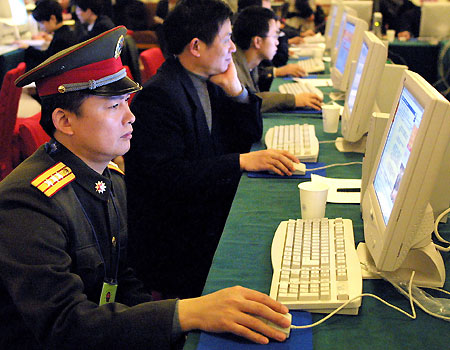
China confirms existence of online warfare team


by Paul Mah:


The Chinese government has confirmed the existence of an online warfare team that it says is trained to protect the People's Liberation Army from external cyber assaults. The unit is known as the "Blue Army" and consists of 30 Internet specialists drawn from various channels such as existing PLA soldiers, officers, college students and assorted "members of society," according to a report published on The Australian.


A former PLA general cast some light on the caliber of these specialists when he told The Times, "It is just like ping-pong. We have more people playing it, so we are very good at it." Underscoring China's commitment to defending itself against cyber warfare, an official PLA newspaper has stated that "tens of millions" of dollars have been invested in the country's military training network.


When asked whether the unit was set up with the express purpose of mounting online attacks on foreign countries, Chinese Defense Ministry spokesman Geng Yansheng talked about how Internet security is an international issue and how China is also a victim. He told the Global Times: "China is relatively weak in cybersecurity and has often been targeted.


This temporary program is aimed at improving our defenses against such attacks." He added: "The Blue Army's main target is self-defense. We won't initiate an attack on anyone

mapping the US blogosphere


From MediaCloud :


One thing that we can use quantitative text analysis for is to get a sense for the overall landscape of a set of blogs. The following map of popular blogs in the U.S. (the top 1000 blogs according to Bloglines) gives a good sense of what topics people write about on popular blogs and how those topics relate to one another:


This map is generated by comparing the similarity of the top 100 words of each of the blogs in the popular blogs set during the first five months of 2011. Each dot represents a blog. We generate the cosine similarity of each blog to each other blog in the set and then designate the 3000 blog pairs with the highest similarity scores as being similar to one another. The map is then laid out using a force based mechanism, trying to push apart all of the nodes, with the 3000 similarity pairs acting as forces keeping those pairs together. So blogs that are similar to one another end up closer to one another in the map. The color of each node is the result of using the same cosine similarity scores to group the blogs into 25 separate clusters according to the similarity of the blogs’ content.
This map tells us that this U.S. popular blogs (to the degree they are represented by the particular Bloglines sample) can be grouped into three big meta clusters: Crafts, News, and Technology. Of these, the Craft meta-cluster is the biggest, and the biggest single cluster with 137 blogs is the big ‘love’ cluster (cluster labels are automatically generated as the most common word within the cluster’s member blogs). This is the most general cluster in the map, as indicated by the fact that it sits closest to the center of the map of any cluster. It is a mix of general crafting blogs and general personal life blogs. A few of the blogs include: [ Wee Wonderfuls ] [ Loobylu ] [ A Dress A Day ] [ Sea of Shoes ] [ PostSecret ] [ still me ] [ Loldogs, Dogs 'n' Puppy Dog Pictures - I Has A Hotdog! ] [ six and a half stitches ] [ CrazyAuntPurl ]. The word cloud for the ‘love’ cluster is strongly dominated by the title world, with mostly crafting words among the next most common:


The next largest cluster, with 44 blogs, within the crafting meta-cluster is the ‘knit’ cluster, which is exactly what it sounds like. According the clustering run, half as many blogs within the Bloglines top 1000 feeds focus on knitting as do on politics (82, which we’ll discuss below). A few of the blogs in this cluster are: [ Lolly Knitting Around ] [ SO MUCH YARN, SO LITTLE TIME! ] [ Grumperina goes to local yarn shops and Home Depot ] [ Twist Blog ] [ turkey feathers ] [ Hello Yarn ] [ Sheri at The Loopy Ewe ] [ Yarn-A-Go-Go ]. The word cloud for the cluster is exactly what one would expect a knitting word cloud to look like, with very strong focus on knitting and differentiation from other clusters:


Another prominent cluster within the crafting meta-cluster is the ‘recipe’ cluster, with 29 blogs. The blogs in this cluster include: [ (Inside A Black Apple) ] [ This American Life ] [ Baking Banter ] [ Cooking For Engineers ] [ Cheap Healthy Good - Frugal Recipes and Food Tips ] [ CRAFT ] [ smitten kitchen ] [ Accidental Hedonist ] [ not martha ]. The word cloud for this cluster consists almost entirely of directly food related words:


Almost all of the blogs and the top words in this cluster are on the topic of food. But the inclusion of This American Life, a radio show not focused at all on food, is a typical artifact of a content-based clustering process. In this particular case, This American Life posts a short summary of each show each week at its RSS feed. Two of the twelve weekly stories posted to its feeds for the time period of this clustering run are about the original recipe for coke and about the Onion, respectively. Because the rest of its stories are so diverse, those two stories, especially the recipe story, are enough to throw it into this recipe cluster.
The news meta-cluster is dominated by the ‘obama’ cluster of news sources. The ‘obama’ cluster has 82 feeds that are a a mix of general news, soft news, and political news in blogs and in mainstream blogs, including: [ Calculated Risk ] [ All Salon ] [ nybooks.com: Latest articles ] [ youtube :: most viewed videos - today ] [ Right Wing Nut House ] [ Overheard in New York ] [ NYT > Arts ] [ NYT > Opinion ] [ Yahoo! News: Top Stories ] [ Waiter Rant ]. This cluster has such a diversity of sorts of blogs because even this diversity of types of news gets swamped by the difference between any kind of news and the sorts of content in the crafting or technology meta-clusters. The word cloud for the ‘obama’ cluster shows that the content in the cluster is mostly dominated by politics, regardless of the diversity of the sources. In fact, the cloud acts as a pretty good description of political news coverage for the six months covered by the clustering run, with top words including not only the obvious ongoing ‘obama,’ ‘republican,’ and ‘democrat’ topics but also more specific topics dominating particular news cycles, like ‘egypt’, ‘libya,’ and ‘japan.’


The final meta-cluster is on technology, dominated by the ‘google,’ ‘app,’ and ‘iphone’ clusters. In this case, the k-means clustering that picks out cluster members (and assigns colors in the map) is able to subtly differentiate between these computer and Internet topics even though they are very closely related, even to close human inspection, but the mapping process (which assigns the position of the blogs on the map) is not able to differentiate among these blogs as well, leading to the dense clump of blogs on the right of the map.
The google cluster mostly consists of blogs that focus on topics directly related to google, including search engines (‘keyword’), search engine optimization (‘seo’), and online advertising (‘adsense’). The blogs in this cluster include: [ TEDTalks (video) ] [ Google Earth Blog ] [ Techdirt ] [ Coding Horror ] [ Google Sightseeing ] [ Daily Blog Tips ] [ Small Business Marketing Blog from Duct Tape Marketing ] [ Adverblog ] [ Gmail Blog ]. There is potential for this cluster to contain some artifact members, since ‘google’ is such a common word on the Internet and is often used for meta-comment (eg. ‘use google to search this site…’). But in fact, every member of this cluster is actually substantively focused on Google or on the issues closely related to Google described in the cluster word cloud:


Finally, the iphone cluster includes blogs that focus on personal technology in general and iphones and ipads in particular: [ Pogue's Posts ] [ Going My Way ] [ ThinkGeek :: What's New ] [ AnandTech Article Channel ] [ MobileCrunch ] [ TechCrunch Japan ] [ Web Designer Wall - Design Trends and Tutorials ] [ Apple Hot News ] [ Cool Hunting ]. Even though the app cluster above includes desktop computing platforms (‘microsoft’ and ‘mac’), blogs about those platforms are only strongly represented in that general cluster. Blogs in the iphone cluster, in contrast, focus strongly on iphones and gadgets, creating a strongly separated cluster:

Friday, May 27, 2011

PayPal slaps Google with mobile payment suit


Just this morning we reported on the rather jovial atmosphere at Google's big mobile payment announcement -- well, it looks like PayPal's prepared to bring an end to the celebration. According to Bloomberg, PayPal filed a suit against Google today in a California Superior Court, alleging that former PayPal executive, and one of this morning's MCs, Osama Bedier misappropriated the company's trade secrets.


The suit further fingered Stephanie Tilenius, also formerly with PayPal, of violating the terms of her contract in recruiting Bedier. Though we've yet to get our hands on any clear details about which trade secrets PayPal's pointing to, we'd say the timing speaks volumes.

Government Investigations Have Frozen Google's Manual Search Results


by "the LAUNCH team"


Google’s search results have been "frozen" from anything but algorithmic changes due to multiple government investigations -- and possible investigations -- numerous sources have told LAUNCH.
Google search results have always been primarily algorithmic. However, it has long been known inside the industry that some human "massaging" or "grooming" has occurred after the algorithm generated results. Sites that were good actors from Google’s perspective (read: Wikipedia, respected blogs, news sources) were moved up, and sites that were considered spam (or low quality) were moved down.


The human touch is not new, nor does Google deny it.


At Google's founding, the human power came from Larry and Sergey, who created a ranking system that rewarded links coming from important sources and penalized those that did not. Those results fueled the PageRank algorithm, which Google still uses today to help determine search results (although to a much lower extent now that PageRank has been wildly gamed, and other signals of quality have emerged such as social sharing and time spent on a page).


Indeed, the term "Google Dance" historically referred to not only Google changing its search results, but the vibrant debate between content companies and Google staffers after those changes. Essentially, content creators have been negotiating with Google since the beginning of Google time.
Three of the top 400 content sites in the United States told LAUNCH that Google had manually tweaked results either up or down.


Google’s search teams have long battled internally over manual vs. algo changes. However, since shortly before the Panda algorithm update in February, the Brass have forbidden search teams to talk about, let alone manually change, search results.
Instead of debating confounding search results with partners (especially since the Panda update), Google has defaulted to sending content owners cookie-cutter legal messages that say no manual intervention is ever done to search results. This is, of course, disingenuous to many who have been in the industry and Danced with Google in the past.


Traditionally, content companies feared criticizing Google publicly -- and they didn't have to because Google was willing to do the Google Dance. Post-Panda, Google has been plagued by embarrassing search results, and some companies in the industry have broken rank.
On March 5, Suite101 CEO Peter Berger wrote an open letter to Google's Matt Cutts [ http://twitter.com/#!/mattcutts ] defending the quality of Suite101’s content and asking Google to stay "committed" to treating content impartially (i.e., not favoring Google’s content over that of competing companies).


On May 5, HubPages CEO Paul Edmondson essentially accused Google of using its dominance in search to destroy competitors and build up its own content sites.
Those kind of aggressive call-outs were usually left to the SEOs of the world--not professional CEOs. Edmondson’s piece was especially damaging to Google because it hit them right where they are being investigated -- and frankly are weakest -- their own content sites (Google Local, YouTube and Blogger).
Our handicapping of the situation is that HubPages and Suite101 felt they had nothing left to lose, after the Panda smack down, by openly confronting and criticizing Google.


Additionally, content providers that once depended on Google search traffic have, in some cases, simply given up trying to work with the firm. Instead, they are focusing their energy exploring other traffic sources such as apps on the iPhone, iPad and Android platforms, as well as social traffic from Facebook, Twitter and Tumblr.
As to whether Google has gone pure algorithm in its search results, a Google spokesperson told us, "Computer algorithms are the most scalable way to deliver relevant results. However, manual controls are necessary to improve the user experience in very limited cases, such as security concerns, legal issues and spam."
LAUNCH translation: "99% of what we do is algorithmic, but we need to be able to correct the obvious mistakes that the algorithm is going to make. This is just common sense, and it’s kind of frustrating that the Obama administration is harassing us over this when Facebook is behaving 1,000x worse than we ever have."
Google believes its process for creating search results is a trade secret and should not be transparent, although Matt Cutts has previously argued -- correctly -- that Google has revealed many "secrets" over the years [ http://googlepolicyeurope.blogspot.com/2010/03/google-transparency-and-our-not-so.html ].


HubPages CEO Edmondson's claim about Google is exactly what the European Commission officially began investigating late last year. The Texas Attorney General’s office started its antitrust review of Google last July and is demanding detailed documents about its search practices [ see http://allthingsd.com/20110216/heres-the-texas-ags-letter-demanding-googles-search-policies-and-ad-rate-formulas/ ].
The Federal Trade Commission (FTC), which investigated (and settled with) Google for privacy violations around its Buzz social network in late March, is considering a broad antitrust case against Google according to a Bloomberg report last month.


When LAUNCH asked FTC spokesperson Claudia Borne Farrell if she would comment on whether the agency is planning to investigate Google’s search practices, she said, "No."


That sounds like a "yes" to us.